
Reviewer Vivian Turnbull Interviews Alice McVeigh, Author of “Marianne: A Sense and Sensibility Sequel”
Two hundred and fifty years past the anniversary of her birth, Jane Austen is more popular than ever. Scholars praise her brilliant ability to blend her narrator’s voice with the inner thoughts of her characters, her Shakespearian societal commentary, and her matchless wit. Her fan base is still skyrocketing … new and ever-more-expensive adaptations of her novels abound.
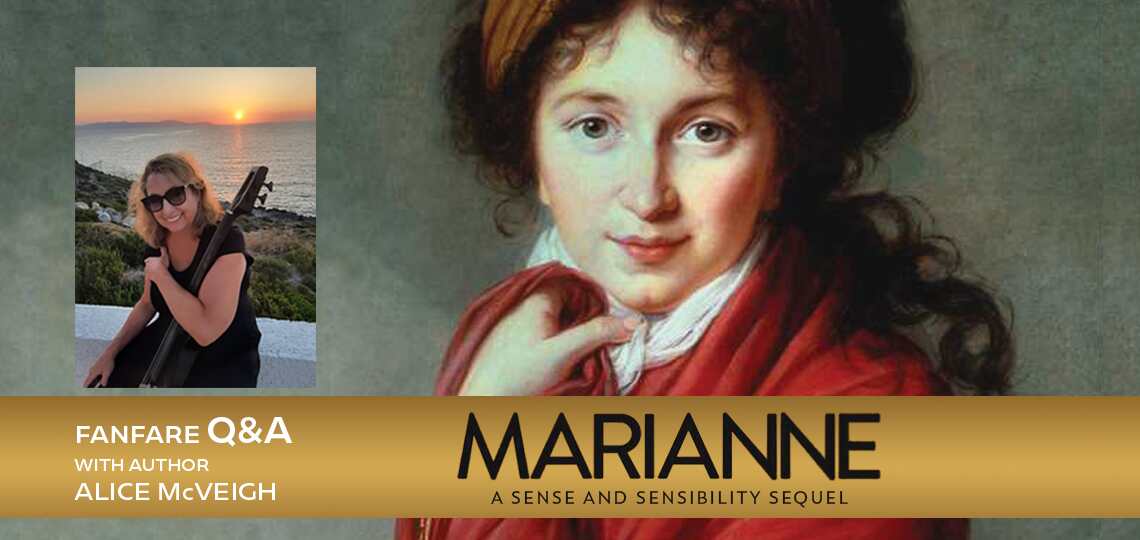
Today, we’re joined by Alice McVeigh, professional London cellist and passionate Janeite—someone who’s channelled her lifelong admiration of Austen into a five-volume, multi-award-winning series combining the characters from Austen’s own six novels in imaginative ways. We discovered this polymath after her Marianne: A Sense and Sensibility Sequel earned a glowing Foreword Clarion review and quickly realized there’s a lot more to this story. Enjoy the conversation!
You’ve written both historical and contemporary fiction—what drew you to writing Jane Austen-inspired literature specifically? I know you’ve spent most of your life in London; has your time there influenced your interest in Austen?
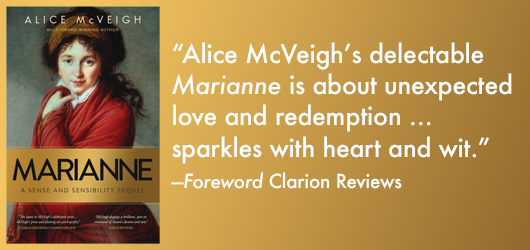
I’ve lived in London since the late 80s. Aged just twenty two, I arrived to study cello for a year with the famous British cellist Jacqueline du Pre, met an Englishman and … stayed. My contemporary fiction arose out of my career as a London-based orchestral cellist. But my fascination with Austen started even earlier. I’d loved Austen’s novels since my mid-teens, but … understanding Austen is a very different thing.
Emigrating to Britain was an eye-opener. Touring with my cello all over the country, performing string quartets at the Tower of London and Hampton Court Palace, playing in the Royal Philharmonic Orchestra at Castle Howard—just living in London—brought, not only Austen, but British history to life, in my imagination.
After re-reading the novels over fifty times each, I found myself fascinated by about how characters in her different novels might interact, were they ever to meet. And, after all, it was not unlikely. Regency society was far from vast. It’s perfectly possible to imagine a play, perhaps at what was then the Little Theatre (now rebuilt as the very Edwardian Haymarket) with cast members from Mansfield Park, Pride and Prejudice, and Emma scattered throughout the boxes …
What was it about the original ending of Sense and Sensibility that you felt lent itself to a sequel for young Marianne?
(Spoiler alert for Marianne below!)
I never doubted that Colonel Brandon made Marianne happy—Austen reassures us on this point, personally. (“Marianne could never love by halves; and her whole heart became, in time, as much devoted to her husband, as it had once been to Willoughby.”)
However, as time went by, I gradually became convinced that, in all of Austen’s oeuvre, no one would suit Marianne better than Henry Crawford of Mansfield Park. The difficulty I had then was that nobody behaves worse in all of Austen than Crawford—the adulterer who selfishly seduced Maria Rushworth. (Though one could make as damning a case, and on the same grounds, for Lady Susan.) Many writers would have supposed Henry Crawford charming but irredeemable—but there, I absolutely disagree. No one on Earth is irredeemable, is one of my fundamental beliefs. People can change, people can grow. “Second chance romance” is a mega-trope in fiction, but I believe in second chances, period.
Austen clearly agrees, as Marianne develops, becoming more thoughtful and mature throughout her Sense and Sensibility. In my Marianne, Marianne continues to mature—she’s still only twenty—but Crawford is altogether altered. What occurs in my sequel—and Crawford’s reactions to what occurs—gives the reader the confidence to imagine Marianne as happy married to Henry Crawford as she had been with Colonel Brandon, perhaps even more so.
You capture the strict rules and oddities of Regency-era England with a delightfully satirical undertone. I think that’s one of the elements readers love so much about Austen’s own work. Tell me about your research process in recreating that world and social commentary.
The rules and oddities are partly what makes historical fiction so fascinating! I grew up with history: my parents and my professor husband are all historians. I can’t pretend to be an academic—embarrassingly, my only degree is a B.Mus. in cello performance—but I was taught from my earliest years how much history matters. For this novel, I particularly enjoyed researching the hierarchy of Regency London, and choosing where to place the characters: Lady Catherine de Bourgh; Frank Churchill and his wife, Jane; Henry Crawford and his sister, etc. (A month ago, attending a Jane Austen Society event, I was charmed to find myself crossing South Audley Street, the very place where I decided Marianne Brandon’s London address might be!)
I was also obliged to master the intricacies of Regency mourning dress: How soon Marianne was allowed to dispense with black, for example, after Brandon’s death. Dress mattered such a lot in the period, women’s dress, especially. (Rules and oddities, indeed!) Similarly, I was fascinated to discover that Sotheby’s auction house already existed, under a slightly different name. I also researched Regency men’s clubs—which club Rushworth would likeliest have chosen, and which Crawford would prefer. While the legalities of the trial scene were mind-blowing. (I was appalled to learn that there was no barrister for the defendant!)
Is it ever intimidating to add your own spin to already beloved characters like Jane Churchill?
Absolutely. Very. No question. But, really, what else is white wine for?! I don’t write anything nerve-racking until the evening, for that reason. I often need to persuade myself that I’m “up to” some important scene or other. Something which, in the chill morning light—I wake up at six—can feel almost impossible.
As for Jane Churchill/Fairfax, the danger is—as I’m confident Austen herself struggled with—of making her too interesting. My Harriet: A Jane Austen Variation is basically Austen’s Emma, told from the dual viewpoints of a rather more clued-up little Harriet Smith and the fascinating Jane Fairfax. (Several reviewers noted that I should have called it Harriet and Jane, which is probably true.) She is annoyingly fascinating—she not only threatened Emma’s supremacy in Austen’s Emma, but she attempted to run away with my Harriet!
Jane Churchill and Marianne also share the honour of being Austen’s most musical characters. Marianne, in S&S, is capable of delivering “a magnificent concerto” on the pianoforte, while Jane comprehensively out-plays Emma Woodhouse in Emma, something which irritated that young lady a good deal.
Part of the story is narrated via Marianne and Margaret’s journal entries while the rest is narrated beyond the journals. What do you think this dual narrative approach adds to the story?
I tried to do without it, but couldn’t find a way. Austen’s genius is to take us into the interior world of, say, an Anne Elliott, without resorting to a journal/first person, beyond the occasional telling letter. But I love the immediacy of first person too much to lose it. I kept a journal myself at sixteen, Margaret Dashwood’s age, and I’m confident Margaret would have done the same. Marianne, perhaps not. But she does in my Marianne, for the sake of that immediacy.
Apart from Marianne, is there a particular character you relate to or enjoyed writing?
(Spoilers below!)
I relate powerfully to Marianne, and always have. Marianne, despite being described by Austen as being almost beautiful, is otherwise very like me. Her impulsiveness is legendary. I was late-diagnosed ADHD six years ago by the UK’s National Health Service, which freed me to return to fiction, as opposed to cello-playing/ghostwriting. In other words, impulse control is not a strength. I can also be too honest, and could hyper-focus for Britain.
I also relate strongly to Henry Crawford, and always have. He’s mercurial, witty, disruptive, and very easily bored in Mansfield Park. In Marianne, he becomes—with greater depth and maturity—irresistible.
And then, there’s young Margaret Dashwood. Jane Austen—perhaps wisely, as it would have unbalanced her book—had neither time nor space for Margaret. In Sense and Sensibility, there’s only exactly one sentence describing her, which I grabbed with both hands: “Margaret, the other sister, was a good-humoured, well-disposed girl; but as she had already imbibed a good deal of Marianne’s romance, without having much of her sense, she did not, at thirteen, bid fair to equal her sisters at a more advanced period of life.” My sixteen-year-old Margaret—soooooo much more of a Marianne than an Elinor—was a joy to write!
Having despaired of equalling Marianne’s musical abilities or Elinor’s clever sketches, my sixteen-year-old Margaret is attempting a Gothic romance. Margaret’s shameless over-writing is strongly reminiscent of my own very first novel, scribbled at thirteen. (There wasn’t a single highwayman in mine, but, had the thought occurred to me, I’m sure there would have been.)
Both Crawford and Marianne undergo significant character development over the course of the novel. Marianne learns to coax open her grieving heart while Crawford finally takes accountability for past wrongs. Why do you think they complement each other so well? Was there ever a point where you planned for Marianne to end up with the alluring Willoughby instead?
(Spoiler alert for Marianne below.)
No. Of course, both are intensely attractive. Not even the sensible Elinor, in S&S, is immune to Willoughby’s charm, while the charismatic Crawfords—between them—completely upend Austen’s Mansfield Park. But my Marianne has developed beyond the Marianne at the end of Austen’s original, and taken ownership of herself at last. Which is why—despite a powerful attraction to Willoughby—she can never quite trust him. I also doubt that Austen would have entirely approved, had Willoughby won Marianne at last. Near the end of Sense and Sensibility she tells us:
“But that [Willoughby] was forever inconsolable, that he fled from society, or contracted an habitual gloom of temper, or died of a broken heart, must not be depended on—for he did neither. He lived to exert, and frequently to enjoy himself. His wife was not always out of humour, nor his home always uncomfortable; and in his breed of horses and dogs, and in sporting of every kind, he found no inconsiderable degree of domestic felicity.”
There’s something rather dismissive in Austen’s tone here, something that suggests, to me, at least, a certain superficiality in Willoughby. And a superficial character could never have satisfied Marianne.
Speaking of Crawford’s past wrongs, you also use his escapades to explore the disparate impact of scandal on women versus men in Regency-era England. What was that process like?
Uncomfortable. I still find it uncomfortable. But then, Austen herself found it uncomfortable, writing in Mansfield Park: “That punishment, the public punishment of disgrace, should in a just measure attend his share of the offence is, we know, not one of the barriers which society gives to virtue. In this world the penalty is less equal than could be wished; but without presuming to look forward to a juster appointment hereafter, we may fairly consider a man of sense, like Henry Crawford, to be providing for himself no small portion of vexation and regret.”
Every reader of M.P. must feel how unjust it is, that Maria Bertram is condemned to be buried in the countryside forever (and with Mrs Norris!) while Henry Crawford saunters about London society, almost unscathed by their shared scandal. But, as I stressed before, I believe that redemption is possible, or else I’d never have written Marianne—which I love to imagine that Austen would like, though it’s my most romantic so far, and Austen herself was never entirely comfortable with romance. One of the commonest errors that Austen fans make—especially those addicted to the souped-up Austen adaptations—is to think that Austen is a romantic writer. She’s primarily interested in social satire, instead.
One of the most captivating elements of your novel is the gorgeous, at times, almost lyrical prose. I love Marianne’s line toward the end of the story, “I was still in grief, still grieving—but he had lifted me, till even my blood was dancing.” You were trained as a professional cellist, and your debut novel was about music. How does your affinity for music shape the way you approach the written word? In what ways is writing a story like playing an instrument?
I’m very honoured you think so! Oddly enough, I just recorded a podcast with Professor Michael Krank, the Austen scholar. He asked me about the link between music and prose, too.
Writing a novel is almost nothing like playing an instrument—except that it takes decades of slog to do either tolerably. While writing a novel is truly creative, playing Beethoven etc., on a cello is re-creative, instead. It can even be creatively frustrating, as most orchestral cellists have no agency … The composer tells us which notes to play. The conductor shapes our every phrase. The principal cellist dictates our bowings. The job of the rest of the cello section is to listen, to blend in, to adjust—and never to stand out. We’re cogs in a machine. And yes, the machine is glorious, but being a cog can feel extraordinarily frustrating. It’s hardly surprising that so many classical musicians spend their leisure hours writing plays, dabbling with watercolours, or making pottery. We are, in orchestras, trained far beyond what we are permitted to do. We are creatives corralled into captivity. Still, being a London cellist has advantaged me.
First, it gave me, when I was young, my Big-Five-publisher breakthrough (with Orion/Hachette, two contemporary novels—recently reissued—exploring “the secret life of a symphony orchestra,” and a symphony orchestra—I’m here to tell you—is like a Regency-esque society in miniature!)
Secondly, my ability to sense the rhythm of Austen’s prose has helped me to inch closer to her glorious style. And yes, it is like music! Beyond Shakespeare, there’s no more rhythmic author than Austen, whose prose was famously compared—in an important tome by Professor Robert K. Wallace—to Mozart. And so, despite the fact that my English accent is still sinking somewhere in the middle of the Atlantic, Austen’s prose has burrowed its way into my bones.
For which I shall always be grateful.
Marianne
A Sense and Sensibility Sequel
Alice McVeigh
Warleigh Hall Press
Clarion Rating: 4 out of 5
A heart is healed, and a future forged, amid the bustling gossip and drama of English society in the charming Jane Austen–inspired novel Marianne.
Set in Regency-era England, Alice McVeigh’s delectable romance novel Marianne is about unexpected love and redemption.
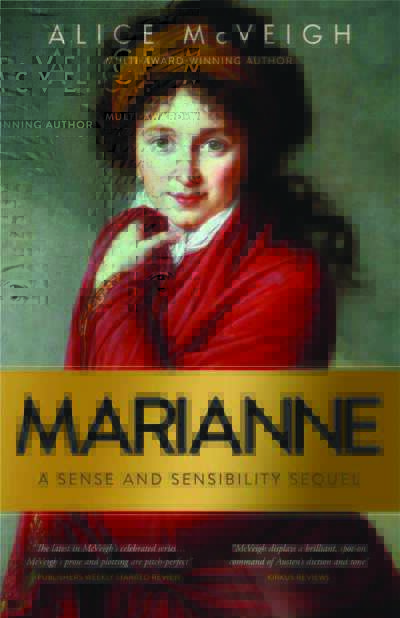
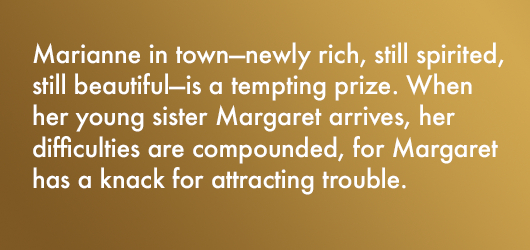
After just a year of marriage to Colonel Brandon, young Marianne is widowed. After she returns to town, her life is upended once more by an unexpected love triangle. Now, with the reappearance of Mr. Willoughby—the lover who broke her heart three years earlier—and the attention of scandal-embroiled Mr. Crawford, Marianne must determine whether she can learn to love and trust again.
The story begins two years after Brandon’s death. Its intricate storyline unfolds in large part through excerpts from Marianne’s and her younger sister Margaret’s journals, which provide a window into the young women’s fears and longings. Few details are given about Marianne’s life with Brandon, however, despite the air of grief that permeates her writings.
Other plotlines, like Willoughby’s marriage and Crawford’s escapades, are narrated beyond the diaries. Much of the expansive cast is drawn from myriad Jane Austen novels, and prior familiarity with the respective works is a boon when it comes to following the complex plot, particularly Marianne’s and Willoughby’s recollections of their past. The list of characters and novels at the beginning of the book helps with the task, though.
The lively cast contributes alternating moments of humor and heartache. Bumbling Rushworth pursues uninterested Marianne with admirable gusto, while the Churchills prove to be steady friends. Young Margaret is a particular delight. She skips through life with winsome cheer and the unwavering belief that thrilling romance awaits. Margaret dreams of becoming a celebrated writer, and amusing snippets of her wild stories are scattered throughout her diary. “Is not ‘perspicacious’ a divinely long word?” she reflects in one lighthearted entry. But Margaret finds more fame than she bargained for when her near brush with scandal propels the plot toward its merry conclusion.
The book’s attention to historical detail and customs is impeccable, as when it describes Marianne’s partial mourning attire. And the book adds an intriguing layer of social commentary as characters discuss the effects of social rules, like the disproportionate consequences of infidelity for women versus men. Poetic prose lends the story further depth, though its overreliance on dashes and ellipses results in some choppiness that detracts from moments of true turmoil.
Characters often hint at their feelings through bits of poetry and playacting, and their borrowed verses pair with stolen kisses to create a thrilling, almost breathless undertone of longing. Indeed, theater propels much of the characters’ conflict and past heartache. The motif of acting and poetry throughout is a fitting parallel to Marianne’s struggle to discern her own heart and then voice her desires. In the story’s climactic scene, a suitor declares to Marianne that her “pilgrim soul can never age” and entreats her to grow old with him. Such poetic declarations elevate the writing without taking away from the raw humanity of the characters. Crawford must still face the people wounded by his carelessness, while Marianne must coax open her grieving heart. Their growth grounds the narrative amid the bustling gossip and drama of English society.
Marianne is a Regency-era romance novel that sparkles with heart and wit.
Reviewed by Vivian Turnbull
November 5, 2025
Vivian Turnbull


