
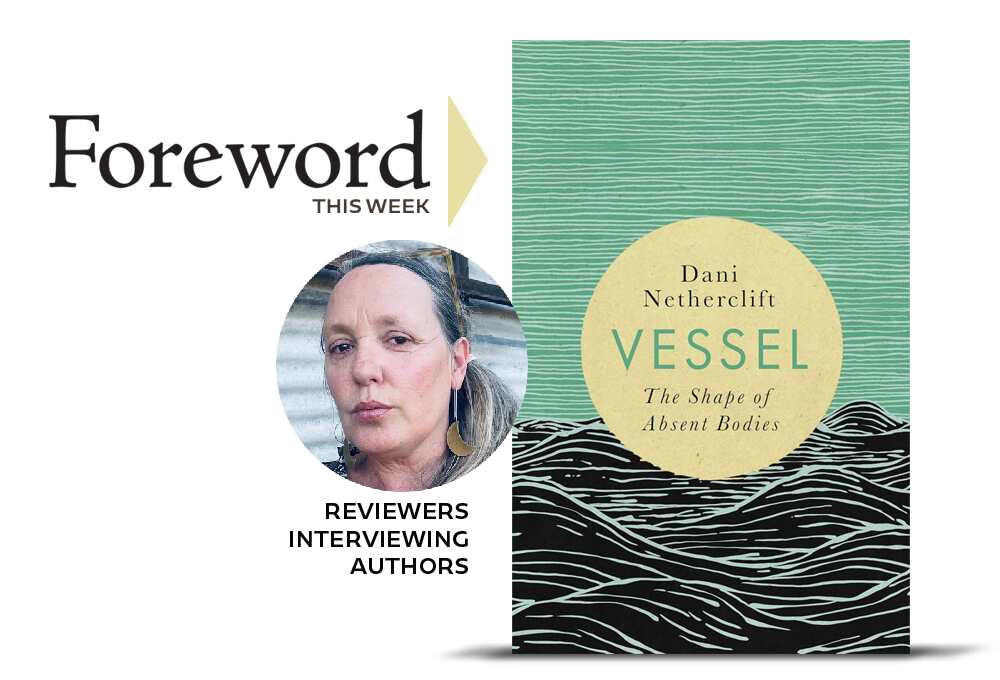
Reviewer Rebecca Foster Interviews Dani Netherclift, Author of VESSEL
“Writing Vessel was a beautiful way of feeling like I was drawing my father and my brother back into the world, remembering them and saying that, once, they were here. I loved weaving stories of who they had been into this lyric sense of understanding presence and absence, and what time does to grief.” —Dani Netherclift
This week’s interview causes our heart to break and double in size—something we didn’t know was possible.
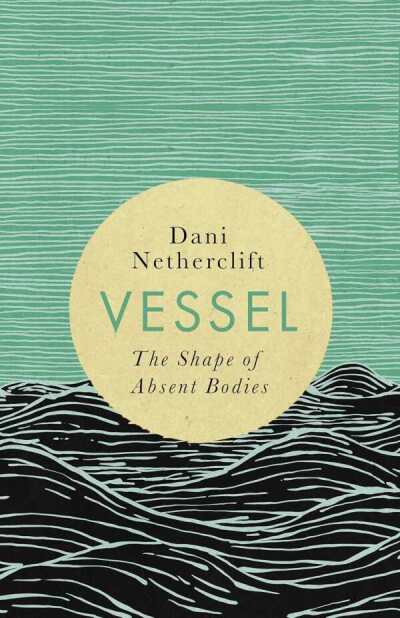
Dani Netherclift joins Rebecca Foster to tell the story of losing her father and brother in a drowning accident thirty years ago and how she continues to live with an inescapable sense of absence. And while she tried for years to write her way out of her grief, nothing felt right until she embraced a visual as well as textural approach, which resulted in Vessel, her extraordinary hybrid memoir.
Rebecca called the book “sublime” in her starred review and we were thrilled when they both agreed to connect.
How did a hybrid form—incorporating photographs and poem-like snippets as well as prose—help you tell your story the way you wanted to? What made you decide to include the WWI-era envelopes?
I was following the conventions of the lyric essay, which allows for a fragmented, non-linear hybrid form. I had tried many times over the years to write about what my family called “the accident,” the drowning deaths of my father and brother, but more traditional forms never seemed to hold what I was trying to write. When I started reading fragmented elegies like Sarah Manguso’s The Guardians and Anne Carson’s Nox, I saw an experimental form that allowed for stories to emerge that might meander and diverge from the path of more traditional forms. Such books display a thinking through of grief, rather than any attempt to necessarily find a resolution or way through. I had been searching for a suitable container to hold my thoughts, and in the lyric essay, I found it. The lineated sections are also something that the lyric essay allows, or invites—this sense of history as a poetics. Another part of what I was trying to do was to create a visual as well as textural artifact, so I wanted the interior of the book to be arresting in the way that you might consider a piece of conceptual art.
Regarding the images in Vessel, the historical news clippings represent other deaths that took place in the system of irrigation channels deriving from this huge, man-made body of water (it was, when built around 1906, the largest irrigation project in the Southern Hemisphere) and are meant to form a part of the text, or “bodies of text.” I was influenced by the archival images in Nox, as well as Emily Dickinson’s envelope poems in The Gorgeous Nothings, and Susan Howe’s representation of the latter in her book Spontaneous Particulars. These envelopes (and the letters they originally contained) have always been in my family. My great-grandmother, who owned virtually nothing, carried them around until she died. They’re beautiful, poignant artifacts in their own right, and they are each addressed to the place where my family and I were gathered directly before we left to go for a swim on the day of the drownings. I thought it would be powerful to think of an emptied envelope as akin to the body after death. As set adrift from interiority in that way.
You mention in the acknowledgements that the book arose from your creative writing PhD project. What other incarnations did it go through before you arrived at the eventual structure? Were parts of it published elsewhere?
Vessel was written as what’s called the creative artifact component of a creative arts PhD. The creative writing formed a kind of practice-based research, where I was seeing what might emerge from the convention of the lyric essay. This work began as a different story altogether, more like the book I’m working on now. My first PhD supervisor looked at all these unconnected fragments and asked what tied them together, and I didn’t know yet. So, I abandoned it and began anew. I’ve learned since then that the connections, or sinews, will emerge via the writing. I had shied away from writing about the drownings, because my older sister had already written a traditional memoir about these events, twenty years earlier. The form of the lyric essay—the fragmentation, work of association, and non-linearity—opened up the possibility of writing into the same space in a very different way.
During the time of my PhD, I wrote quite a few short-form pieces of fragmented lyric essay to get my head around the conventions of this kind of writing, and these were published in various Australian literary journals. Now that I think of it, I did excerpt a section of one of these pieces, called “When Alive, My Brother Bore No Resemblance to Mermaids,” originally published in the Australian journal Westerly.
In Abraham Verghese’s novel The Covenant of Water, one person in each generation drowns: a “Condition” that is somewhere between medical and mystical. Did you ever feel that your family was cursed?
I haven’t read The Covenant of Water, but I’ve just looked it up and will add it to the TBR list right away! I mention in Vessel that there were a number of other deaths over generations in my family. The first was a pair of brothers aged ten and twelve in what was then called the Devil’s River, outside the town where I now live. They were my great-great-grandfather’s brothers. Then, my great-grandmother’s first cousin, Charles, died on his 16th birthday in the Waranga Basin trying to save a man’s hat. In the 1980s, my twelve-year-old second cousin, Mark, died in a lake swimming pool during a lesson.
Reading the above, in addition to the drowning of my father and my brother, you’d be forgiven for thinking some kind of curse might be involved, but the truth is that all these deaths occurred in different strands or branches of my maternal lineage. I thought I read somewhere, years ago, of the family who bought my childhood home when we left it in 1986, that a father and brother drowned a few years after my own father and brother, and that made me pause for a moment, but it could have been a dream I had. I think accidents are so often a matter of bad luck, or timing, and that on any other day, things might have played out benignly, and that’s as much meaning as can be gleaned. Life doesn’t always make sense.
You were eighteen at the time of this family tragedy. Looking back with the wisdom of years, what do you wish you could have done differently on the day of the drowning and in the immediate aftermath?
I don’t think we could have done anything more than what we did at the scene of the accident. If I was granted the gift of prescience, we wouldn’t have gone to swim in that place at that time. In the immediate aftermath, I would have written more things down, and I would have viewed at least the body of my father, and taken that chance to be able to say goodbye, as I recently did with my mother.
In what ways are your father and brother still with you, more than thirty years after their deaths?
Writing Vessel was a beautiful way of feeling like I was drawing my father and my brother back into the world, remembering them and saying that, once, they were here. I loved weaving stories of who they had been into this lyric sense of understanding presence and absence, and what time does to grief. As I’ve mentioned, I found some old journals of my brother’s during the process of writing the book. After so many years, it was incredible to have this access to his interiority. He felt so incredibly present within those pages. As I grow older, I have more appreciation for the gifts my father left, the traces of the man he was, as a butcher who loved animals, and who tried to leave behind the family trade so as to begin a travelling plant nursery instead. After my mother died, a ninety-nine-year-old relative sent flowers with a card saying, “Memories are precious,” and though that seems quite the cliché, coming from her, I thought of how deeply true the sentiment is, and how the memories of my father and brother are what keeps them in the world.
Rebecca Foster


