

Reviewer Michelle Schingler Interviews Samantha Ellis, Author of ALWAYS CARRY SALT
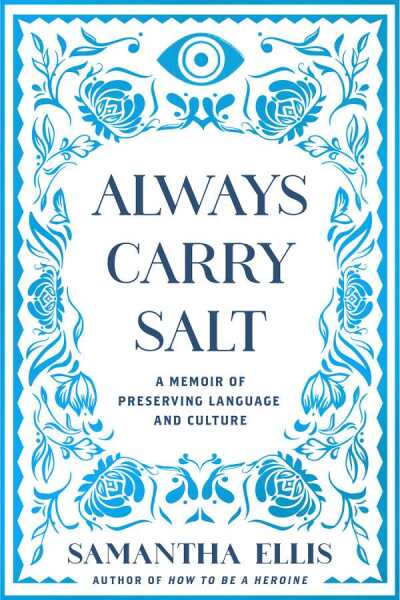
On the occasion of her newly released Always Carry Salt this week, Samantha Ellis joins Editor-in-Chief Michelle Schingler to talk about the heartbreaking exodus of 135,000 Jews from Iraq in the early 1950s, and the imminent extinction of the language spoken by those displaced Jews. That Judeo-Iraqi Arabic was the language of Samantha’s childhood—her milk language, as it were—and having to “face up to the fact that it will go extinct … was devastating,” she admits, though it also made her want to better understand what she was losing. That deep dive led to this immensely important memoir.
Enjoy the conversation; check out Michelle’s starred review of the book.
For the uninitiated, can you say a bit about what milk languages are, and specific to your book, why you felt the absence of yours so acutely?
The Moroccan author and translator Ghita El Khayat coined the idea of a “milk language” to describe the language spoken by your mother when you are tiny, the language you’re sung to sleep in, or soothed in, the intimate, nurturing language of home. My “milk language” is Judeo-Iraqi Arabic, the language of the Iraqi Jews, spoken for centuries in Iraq, and now dying out because most of Iraq’s Jews left in 1950–1951, and in the diaspora it has been mostly suppressed or lost or forced out by other languages. I grew up with it all around me so although I never spoke it, it was like a river I swam in, a place of deep comfort. Having to face up to the fact that it will go extinct, almost certainly in my lifetime, was devastating, and it made me want to learn more about what I was losing before it was gone, and to salvage what I could.
Language isn’t the only element of Judeo-Iraqi culture that you discuss longing for; indeed, appeals to food run throughout the book. What dish or dishes would you make to satisfy a strong bout of homesickness, or to introduce the culture to others?
It’s funny because I was determined not to put any food in the book, but it crept in and kept going and now it’s quite a big part of the book. The mighty food writer Claudia Roden once said that when culture gets lost, the food is the last to go, and I think recipes really are magical, because you can follow them and recreate something your ancestors tasted; it’s almost like time travel. For me, the Iraqi Jewish comfort food is kichri, which is a red lentil and rice dish rounded off with fried onions and melting slabs of halloumi and topped with yogurt. It’s everything I want in a dish.
You write about reworking a few traditions whose origins are shrouded in mystery, as with the Lilith bowls. Can you talk about why putting into practice traditions whose particulars have been lost to history is a powerful means of exercising one’s own culture?
I am really interested in the way rituals can become really powerful mechanisms for generational healing, which, after all, we all hope we are passing on as well as the trauma. When my son was born early our rabbi suggested a blessing for a premature baby from Ritualwell, a feminist group which curates and creates new Jewish rituals for occasions that haven’t traditionally been catered for; I am not particularly religious but found it so comforting to have this blessing that spoke directly to what my baby and I needed.
I was also really fascinated to discover that Iraqi Jews were central to a really mysterious set of rituals that started in sixth century Babylon. For two hundred years, Babylonians (mostly Jewish, but non-Jews did it too) made magic bowls with tiny writing spiralling around them and sometimes drawings of demons, especially Lilith, who they wanted protection from. But when I went to the British Museum in London and was able to hold and handle the bowls, they didn’t feel like traps for demons, and I wondered if in fact the women (I believe that the bowls were often made by and for women) were making Lilith tiny earthenware homes, places of safety. I haven’t actually made a magic bowl but I would like to, and I’m very interested in the way they speak to women today.
What was most illuminating to you in your research of Judeo-Iraqi culture—what revelations struck you the most? And what do you wish people knew more about Jewish life, and the current absence of that once rich culture, in Iraq?
I really loved listening to more of the music made by Iraqi Jews. From the 1920s until the departure of most of Iraq’s Jews in 1950–1951, most musicians in Baghdad were Jewish. This was partly because there was a school called Dar Mu’asat Al’Amiyaan (the House of Consoling the Blind) which was set up by a Jewish businessman to teach blind children skills so they could work. It was open to children from all communities but it was mostly Jewish children who went, and they had amazing music teachers and several of the children went on to become famous musicians. They could play for Muslim women who felt comfortable unveiling in front of performers who couldn’t see, and they joined the Iraqi state radio band, which was led by two Jewish brothers, the al Kuwaiti brothers, who composed hundreds of songs and more or less invented modern Jewish music.
I wish people knew more about this story which was largely suppressed; when Iraqi Jewish musicians went to Israel they were encouraged to play western music, while in Iraq, Saddam Hussein himself oversaw a committee that erased the names of Jewish musicians. I loved listening to their music, but even more so to Salima Murad, this incredibly glamorous Jewish diva who was known as the Voice of Baghdad and who sang these really dramatic and beautiful songs; there’s one about how if her beloved doesn’t come she won’t make tea but will smash her teapot with an axe. My mother knew her and heard her sing, and there are photographs of her with my grandparents. When my grandmother was dying in 2023, we found some of Salima’s music on YouTube and played it to her. I wouldn’t have known to do that if I hadn’t been on this journey with my family story.
One of the reasons you started to work on your reclamation of Judeo-Iraqi Arabic was to be able to pass it on to your son. What elements of the culture does he seem most drawn to, and why?
My son was two when I first started thinking about this book and he’s eight now (it took me a while; blame the pandemic!) but he’s really still at the start of his journey with it. He used to be an incredibly fussy eater, and he’s still not the most omnivorous child, but it’s striking that some of his favourite foods are Iraqi; he especially loves kubba shwandar, where you pound spices, meat and parsley, wrap it in a shell of more pounded meat and ground rice and simmer it in a sweet and sour stock rich with beetroot which stains the kubba ruby red. He’s quite good at saying some of the words, too; his accent is better than mine! I have tried to be careful in how I tell the more difficult parts of our story, not wanting to pass on generational trauma, but he is becoming more aware of why our community left Iraq, and he’s very interested in some of the stories. I was very proud when he recently chose to interview my father for a family history project.
What are you working on next?
I’m exploring so many ideas right now, including a semi-secret fiction project; I have mostly written nonfiction over the past few years but I started as a playwright, so storytelling has always been important to me. I’m also thrilled that one of my plays, a feminist romcom called How to Date a Feminist, is being produced this year in Germany, Italy, the Czech Republic, and Thailand.
Michelle Anne Schingler


