
Reviewer Kristen Rabe Interviews Maya Jewell Zeller, Author of Raised by Ferns: A Memoir
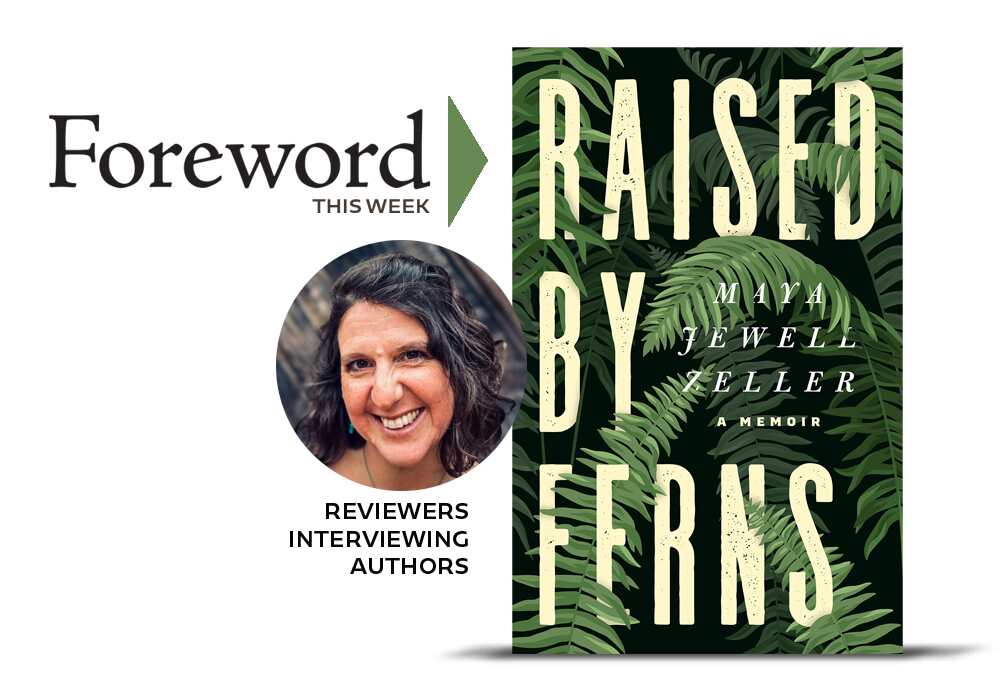
“I know this sounds glib, but I don’t think of literary writing as communication so much as I think of it as making art with language.” —Maya Jewell Zeller, author of Raised by Ferns
Glib or not, thank you Maya Jewell Zeller for putting all writers on notice: If you write and if you hope to attract discerning readers, don’t stop working the craft—draft afta’ draft—until you understand what poets mean when they say: I didn’t finish as much as I gave up. That’s as good as I got.
This is a special interview. Kristen, take it away.
In Raised by Ferns, you’ve written a memoir as a series of essays rather than a continuous narrative. How does this approach offer fresh options for telling your story?
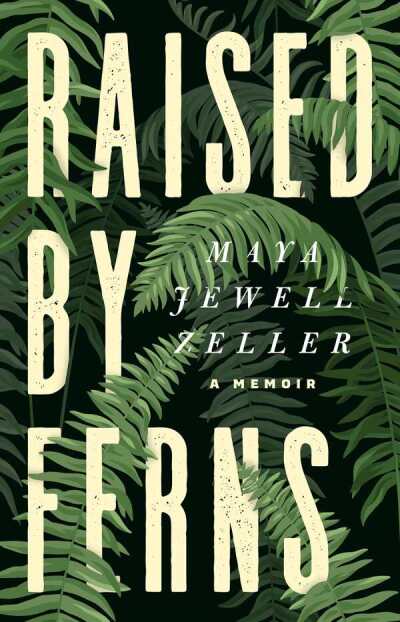
Have you ever tried to dig up a fern? Underneath each individual frond runs one continuous rhizome. I hope the book feels like this: there’s a throughline (or branching tuber) from which spring so many stipes and blades and sori. Or if you prefer a less botanical metaphor, imagine a teenager’s bulletin board, filled with ephemera. The photos, tickets from concerts, a skin of onion, and other mementos collect into a whole. I’m a fan of the collage approach to any form, and especially the memoir-in-essays. The central character, and primary narrative, exists alongside the various threads explored in each chapter or essay, so each has its own sense of denouement. The whole collection gathers, like a prose poem or poetry collection, through the accretion of image and sub-plot, moving with momentum toward the end.
In Raised by Ferns, I start in the present: speaking from the adult self, uncomfortable in (and pushing against) her middle-class HOA life. She’s hoping she can give her kids something good, saved from her own half-feral youth. In the second essay, I go back in time to the gas station where she was born—and then we wander in and out of present and past, as well as deeply into various Pacific Northwest places. Temporality and geography both get a little wobbly. The chapters-as-essays allow this divergence, as they each play with their own shapes, their own aesthetic range.
This essays-building-a-story approach isn’t new: Elissa Washuta’s My Body is a Book of Rules and Annie Dillard’s Pilgrim at Tinker Creek are two other, very different examples. The former, like my book, plays in various forms/shapes; the latter contains lyric narrative chapters that each could stand on their own as essays (though Dillard has cautioned us against thinking of them like that). Other recent examples include Kathryn Nuernberger’s essay collections (including the just-out Held) and Kiki Petrosino’s Bright, which is actually longform fractured prose (operating like docupoetics, the book includes archival research and lyric memoir).
Raised by Ferns is loaded with nature references, including the evocative title, but you resist romanticizing or embellishing your descriptions of natural beauty. What role did nature play in your childhood?
In the title essay, we joke that I don’t understand America (my then-husband said “Maya, you aren’t the demographic for anything”) because I was “raised by ferns.” My family of origin moved a lot, so I didn’t root into any specific social communities or friendships. Instead, each time we arrived in a new (rural) location, I knew where I was by the foliage and animals that lived there—and, if the township was large enough, the library! I recognized my friends: salal and huckleberry, redcedar and plover and hemlock. In “Sestina for Foragers,” I detail how I could count on the forest’s edible berries, and elsewhere, an old farmstead’s plum trees for fruit and shade. But I also knew the natural world was not benevolent. The violence of a flooded river could take the deck off a house on a riverbend, and the rain coming down a mountain could wash out a road, trap us in a valley without power. Coyotes and racoons killed my pet ducks. Nature was, at best, a consistent yet indifferent companion; but given a choice between Man or Bear, I’d obviously choose Bear—then and now.
Because your family was working class and, at times, bordered on being homeless, some may be tempted to put this memoir in a category with Hillbilly Elegy or various rags-to-riches tales. But you stubbornly avoid what you call “transcendence porn” or “poverty porn.” Why do you feel that way? How instead would you characterize your childhood and your success as a teacher and writer?
I’m not interested in joining that trope—and I specifically name Hillbilly Elegy as the antithesis to what I’m doing. In fact, the essay “Ruin Porn” was, for a while, called “Not Another Hillbilly Elegy: Writing Against Ruin Porn.” In it, I explain like this:
“The genre is termed ‘poverty porn.’ It lenses on the ‘beauty of poverty,’ often oversimplifying, excerpting, and celebrating traits of those who live with less, materially but also less access to resources such as education and healthcare. … But that gaze isn’t comprehensive—it’s a gaze, after all, not a nuanced knowing, and it often ignores systems of oppression, intersectionalities … it fetishizes and further glorifies its own fetishizing of specific groups, or worse, additionally vilifies or makes caricatures of the members of those groups.”
To be honest, I struggle to characterize my childhood in just a few sentences. So, I won’t! That’s part of why I wrote the memoir. Understanding a life takes more than clickbait categories. It demands attention and time. I hope people will take the time not only to read this memoir, but also to read others that witness non-mainstream lives in America: not to reaffirm the norms, or fit into the assumptions and patterns, but to challenge them. In 2026 America, we are too quickly siloing into camps of who belongs here and who doesn’t. We’re witnessing our neighbors choose whether to turn on each other or help each other. The latter is more possible when we read, listen, and pay attention to stories of many different people, especially those whose stories are unlike our own.
I admire the way you combined autobiographical and cultural commentary in witty essays like “The Privilege Button” and “Complete the Sentence.” What were you trying to communicate with those pieces?
Thank you, Kristen. I know this sounds glib, but I don’t think of literary writing as communication so much as I think of it as making art with language, inviting us to get into the visceral body and consider how else we might see the world. But those two essays you mention do get closer to trying to say something specific. “The Privilege Button” creates a fragmented narrative by weaving together the text of HOA “protective covenants” with research/sources and self-reflection. It introduces and characterizes an educated narrator: a married woman, mother to two children, living with relative socioeconomic stability, as she and her husband have sold their (more modest, structurally flawed) home and moved to a neighborhood with a homeowners association.
The HOA feels to the narrator to have all the (often guilt-inducing) markings of middle-class privilege: automatic garages, sprinkler systems, toys for outdoor recreation. Yet she has spent many of her adult working years as nontenured/adjunct faculty at a private, liberal arts university where most of her students can never fully comprehend what privilege means. The narrator struggles with both her relative advantages and her distance from her formative identity. We get the feeling she does not know how to arrive in, or stabilize within, her own stability. She knows that privilege is reserved for the lucky, those who can navigate systems, or who are born into systems, of privilege. And so the opening essay sets up the book’s arc and central character, a mother and academic struggling inside those systems, which include a traditional, oppressive marriage, and a too-normative life in suburban America—a life pulling taut and fraying.
This sense of instability within privilege is continued in “Complete the Sentence,” written by collaging the syntax and language of tests: the SAT, second-grade spelling and language comprehension exams, with the ways that the law tests us. It contrasts my parental concern for my son, who often struggles within typical academic approaches, with my own childhood, in which those academic approaches were keys to a “successful” future out of poverty, at the cost of leaving behind the wildness of unschooled imagination. That essay suggests the tools we use to assess and measure are themselves flawed, that multiple choice tests don’t give us enough ways to “complete a sentence.” Instead, the essay encourages open, creative, individual-based approaches.
The essay “On a Beach in Oregon, 1970s Gasoline Shortage” is a beautiful, nuanced exploration of the connection between the stories we tell about our lives and “What’s Real, What’s True, What’s Worth Retelling.” What is the interplay between truth and fabrication in writing memoir?
In one of her Frank Sonnets, the poet Di Seuss writes:
“The sonnet, like poverty, teaches you what you can do
without. ‘To have,’ as my mother says, ‘a wish in one hand
and shit in another.’”
And in “What is Creative Nonfiction,” Lee Gutkind notes:
“‘Freedom’ and ‘flexibility’ are words I like to use when defining creative nonfiction, for the genre invites writers to push boundaries and open doors, offering them the opportunity to use all of the techniques of the fiction writer (or the poet)—dialogue, setting, description, inner point of view (seeing the world through the eyes of the person about whom they are writing)—in order to capture a reader’s attention and enlighten and intrigue them through nonfiction.”
Writing memoir isn’t about fabrication so much as memory and speculation—the perhapsing we do when we are imagining our futures or filling in the sparse details of our pasts in order to make meaning. Maybe the curtains were blue, or maybe they were simply white with blue flowers. I don’t fabricate, or imagine, unless I tell the reader we’re going to imagine together. Trust is important to me. I want my reader to know I’m not full of shit, even when I’m making something small out of “a wish in one hand/ and shit in another.” I’m just doing my best with the materials I have. Scavenger aesthetic. But, on the page, I’m trying to make truth—whatever it really is—as clear as I can.
At several points in this book, you highlight the advice you give to your writing students. How would you guide someone interested in writing memoir?
Since memoir exists at that wonderful intersection between genres—fiction, poetry, and journalism/biography—I’d suggest to anyone who wants to try it to read widely. Don’t limit yourself only to the books commercially popular in the genre. Read—and listen to!—anything you love, anything that you consider a model. Forget comps for the market. Just bring into your body and brain what brings you joy, what brings you to the page, spillingly. For me, that’s often poetry, sometimes novels, short stories, fables, fairy tale, and experiment. It isn’t traditional memoir. Let your canon be as wide as your rhizome of influence across genre, as well as outside of literature. Is there a music album that defines you? A museum that feeds your sense of chaos or order? A river whose silt lives rent free in your cells? Those influences are part of your canon. Let them shape your syntax, your book’s structure, your forms. Lean into your own world. Let it build itself into language.
Kristen Rabe


