

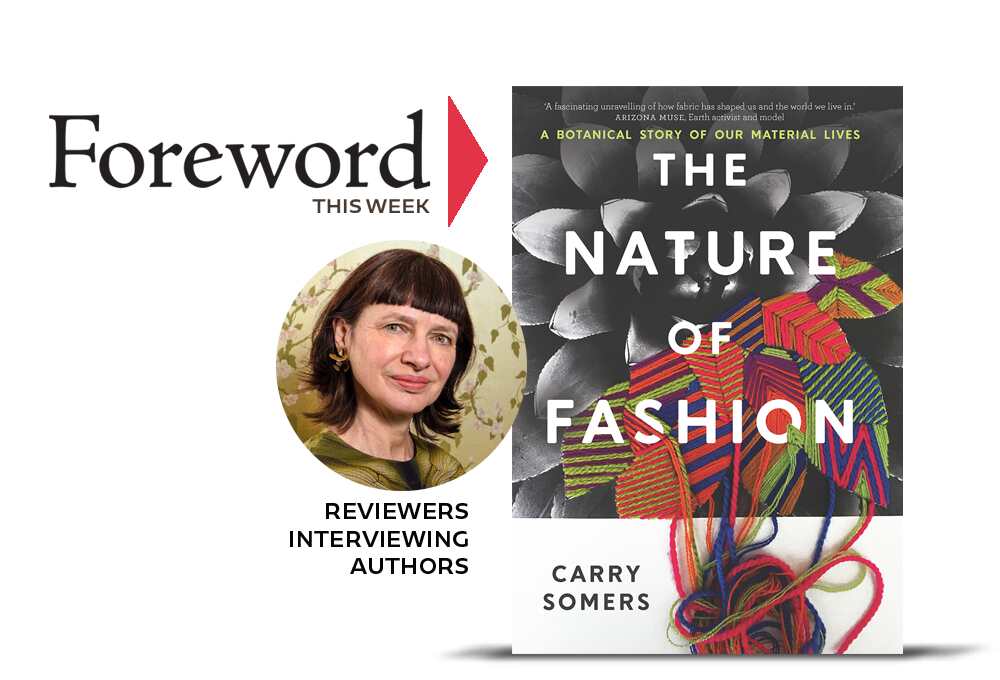
Reviewer Carolina Ciucci Interviews Carry Somers, Author of The Nature of Fashion: A Botanical Story of Our Material Lives
As your Christmas shopping winds down to crunch time, the ghosts of Christmas past will inevitably push you down the ugly sweater aisle and you will be helpless to resist spending good money on offensive clothing. But don’t beat yourself up because it’s a story that has been playing out for thousands of years according to archaeologists who discovered a piece of string that’s at least 41,000 years old.
So it’s not a stretch to imagine our Stone Age ancestors using plant-fiber string to make a seasonal fashion statement—perhaps, a wooly mammoth-haired cardigan with opossum-tail fringe, red fox collar, pink salmon skin pocket square, and buttons made of Neanderthal knucklebones, all stitched together with stinging nettle string. Fabulously hideous, darling.
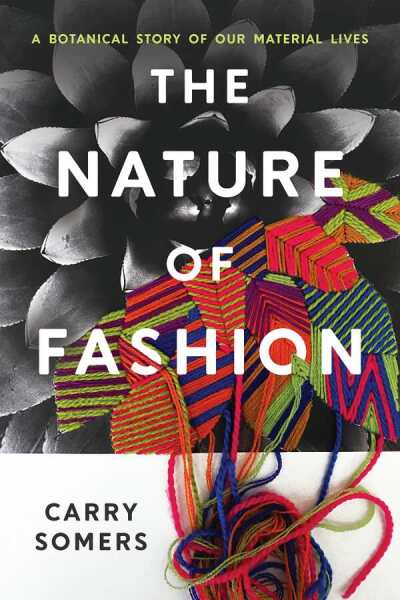
Apologies to Carry Somers for that undignified intro—but she is indeed with us today to talk about The Nature of Fashion and how humans have used plants to make textiles and clothing across time. In her recent review, Carolina Ciucci calls the book fascinating and captivating as it advocates “for more sustainability within textiles industries.”
As you do your last minute shopping this week, let Carry’s words guide your purchases.
The Nature of Fashion is built upon stories. How was the process of tying what, at first, appear to be disparate narratives together into one cohesive whole?
My research mixes science and archival work with stories of people from around the world, woven together with my own voice as narrator. At first, some of the stories did feel disparate, but the more I wrote, the more I realised that fibres provide the connective tissue between them. Texts and textiles have long been linked, and each story is a thread; the book’s cohesion comes from tracing how those threads cross time and place.
Information on its own only tells part of the story; facts and numbers can’t hold memory or emotion. My approach combines rigorous research with imagination—not to distort facts, but to restore what has been omitted. In the preface, I write about the inequality of the archives, especially in matters of gender, class, and race. The deeper I burrowed into this research, the more evident those imbalances became.
Record-keepers determined whose lives would be preserved for future generations, and their silence is most deafening when it comes to those they deemed insignificant. The stories of ordinary women are largely missing from chronicles designed to showcase the feats of extraordinary men. Women remain at the selvedge of history—stabilising the seams, preventing the fabric from fraying—yet their contributions are too often overlooked, their voices hovering at the margins while men fill in the words. When the written narrative excludes half the story, a margin of doubt runs down the edge of every page. The same is true for Indigenous Peoples around the world, then and now.
When archives privilege the voices of explorers, colonisers, or scientists, imagination is a way to listen to voices of the past who were excluded. As Einstein famously said, “Imagination is more important than knowledge. Knowledge is limited. Imagination encircles the world.” It helps me interpret what archaeological papers actually meant for people and place. Throughout my research and writing, my aim has been to listen to what the voices of the past have to say, allowing them to speak in their own words where possible, and to imagine with sensitivity where records fail them.
The book stands at the intersection of rigorous research, storytelling, and personal reflection, all told in an evocative, literary style. How did you go about finding a narrative voice that let you blend all these threads together?
Fashion urgently needs new narratives—ones that reconnect us to the natural world and to our shared human history. And while there are plenty of books that unpick various aspects of the industry, I felt it was time for a different approach, one that reached beyond the world of fashion with a more lyrical, storytelling voice. Perhaps reaching those who would never pick up a book about what we wear.
I wanted to show that fashion isn’t just an ephemeral garment, churned out in a factory; it’s a story woven through landscapes, cultures, and millennia. To do this, I needed to find a voice that could move between research, storytelling, and personal reflection—one that could follow the thread of how we got here, and crucially, point toward a different direction of travel for the future.
I kept returning to a quote by one of my favourite writers, Eduardo Galeano, who said: “I tried, I still try, to write about women and men who have a will for justice and an urge for beauty, unbound by the borders of maps and time, for they are my compatriots and my contemporaries, no matter where they were born or when they lived.” That idea—of writing across borders of time and place—shaped the form the book ultimately took.
And of course, I was never going to write a typical nonfiction book. Whether I’m running a communications campaign or crafting a story, I always begin by trying to see differently. I want to take the reader with me: to evoke not just settings, but sounds and smells; not just facts, but feeling. My hope is that readers—and listeners, since I narrate the audiobook as well—feel not only informed, but present in the long, entwined story of people, plants, and cloth.
You warn of the dangers of seeing nature as a resource separate from humanity, and offer perspectives from cultures who think otherwise, like the Guaraní. How do you think people could be encouraged to step away from this narrative they’ve been told?
We’ve been taught to see nature as separate—as a resource rather than a relationship. Even our name, human beings, suggests a static state. In The Nature of Fashion, I return again and again to the Guaraní concept of becoming instead of being. In their Amazonian home, they traditionally used the red seeds of achiote to mark their path through the forest: colour as a living map, guiding them toward an ever-unfolding future. Life was an ongoing act of transformation. And while we may not navigate by colour in the same physical way, we, too, rely on cues in the natural world to orient us. When those cues vanish—through deforestation, floods, or any other aspect of our changing climate—we lose a sense of who we are.
Ultimately, I hope this book is more than a history of how we transformed plants into cloth: it is a map towards our material future, one where plants are again revered as the very foundation of life—as they rightfully are. In a curious twist of etymology, the word map derives from the Latin mappa, meaning a signal cloth or flag. Just as a flag marks direction, the unfurling story of textiles offers clues to the paths we might choose tomorrow.
Encouraging people to step away from the old narrative begins with a different way of seeing, a map back home—not to a physical location, but to a new way of being. If we can revive that mindset, we can start to imagine fashion, and our place in the world, as part of this continual transformation. Becoming rather than being.
You mention in the acknowledgements that the roots of this book go back to your masters in Native American studies. How was the idea born, and how did it develop throughout the years?
Many of the stories in The Nature of Fashion trace back to papers I wrote during my Masters in Native American Studies at the University of Essex in 1990. I explored everything from how the sixteenth-century Peruvian chronicler Guaman Poma de Ayala’s drawings help us see the world differently to the navigational methods of early explorers. At the time, I had no intention of turning that body of research into a book—but I had always wanted to write.
During my studies, I fell in love with the work of Uruguayan writer Eduardo Galeano, particularly his Memory of Fire trilogy. His books provided an accessible and deeply imaginative way to understand the history, politics, and economics of Latin America, from the earliest origin stories to the present day. The idea of storytelling as a way to weave together disparate threads stayed with me.
Over the years, I had started a few book projects, most of which are still bubbling away, but this was the one that finally fell into place. The ideas, the research, and the stories I had accumulated over three decades finally converged.
One of the threads of the book is the interconnectedness of everything. Why do you think modern Western society has adopted opposing beliefs throughout the centuries, and how can we come back to this mindset?
One of my key discoveries while researching this book is that this separation of humans and nature began far earlier than we often assume. I’d always placed that rift in the Enlightenment period, when the philosophers responsible for shaping modern thought diminished everything non-human to instruments of purpose. But archaeology shows that pattern repeating much earlier. Around 6400 BCE at Çatalhöyük in modern-day Turkey, for example, people destroyed the oak forests they depended on—trees they used for clothing, as well as for construction—and the city collapsed. This is what happens when we build a worldview that treats nature as something outside ourselves—raw inputs rather than a living system.
Fashion absorbed that same logic, turning plants into commodities, stripped of their relationships.
Coming back to a mindset of interconnectedness isn’t about nostalgia. The past shows that when communities understood themselves as part of a wider ecology, they created systems that thrived. What we need now is not to return to the past but to learn how to see differently. Once you recognise that every fibre, every colour, is part of a larger web of relationships, the idea of separation falls away and a different way of living becomes possible.
Resistance is another thread. Much of your work in the last decades has been about sustainability and ethics. How does fashion, and textiles in general, play a part in the contemporary resistance movement?
One of my “works in progress” books is around fashion and resistance. If you look across history, textiles have long been employed in resistance movements, from the symbolic to the functional. As I researched The Nature of Fashion, I saw time and again how cloth became a way to assert identity or push back against systems of power, from the Kuba weavers in the Congo responding to colonial extraction by making their garments bolder and brighter to Yolanda Contreras in Peru, who persisted in growing coloured cotton despite a government ban. When Yolanda defied the authorities to revive coloured cotton, she did more than maintain her cultural heritage. By choosing coloured cotton fibres, we eliminate the need for harmful synthetic dyes. These not only pollute our ecosystems but recent research—including a paper currently in review on which I am co-author—reveals that they prevent even natural fibres from breaking down in aquatic environments.
Fashion Revolution arose from this same lineage. When the Rana Plaza factory collapsed and I saw artisans searching through the rubble to prove which brands were producing there, I knew from ongoing work around transparency with my own brand, Pachacuti, that it was the lack of visibility and responsibility that cost all those lives. Asking a simple question: Who made my clothes? was powerful, because it disrupted a system built on invisibility, exposing the structures that treat workers and ecosystems as expendable.
Textiles sit at the intersection of labour, land, and culture, meaning they continue to be at the frontline of resistance today. Every decision about what fibre or dye to use is a decision about what kind of world we want to live in. Fashion and textiles remain one of the most powerful, and accessible, ways to resist.
Carolina Ciucci


