
Rethinking Animal Perspectives: An interview with Jessica Mann, author of Uplift

Editor Danielle Ballantyne Interviews Jessica Mann, Author of Uplift
Have you ever dreamed of seeing the world through the eyes of a wild bird?
Mythology and Indigenous peoples’ tales have always embraced the fact that animals feel and think and communicate in extraordinary ways, but other than fantasy and children’s book authors, why is it that so few writers of contemporary literary fiction put nonhumans at the center of their novels?
Jessica Mann set out to change all that. A naturalist, conservationist, and lifelong observer of the natural world, she had no doubt that “there were many other intelligent, sentient beings in the world with stories to tell,” as she says in the interview below.
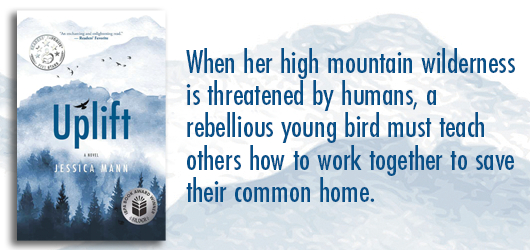
Her immersive, multiple award-winning debut novel, Uplift, unfolds entirely through nonhuman perspectives. The book features Columbina and her close-knit family of Clark’s nutcrackers; Halcyon, a Belted Kingfisher; Junius, a Green Darner dragonfly, and other non-human characters, all penned with realism and complex, multi-faceted personalities.
Celebrated for its lyrical prose and profound environmental themes, Uplift is an enchanting story, rich in allegory and certain to inspire teen and adult readers alike.
Fresh off a complimentary Foreword Clarion review, we connected editor Danielle Ballantyne with Jessica to hear more about the skills she uses to inhabit the hollow bones, hearts, and minds of feathered creatures.

From its characters to its worldbuilding to its syntax, this novel is truly a singular debut. Where did you draw your inspiration from?
A deep love for nature and animals has been my guiding star and source of joy and inspiration my entire life. I knew I wanted to give back in some way with my writing, to share that feeling and hopefully inspire greater understanding and compassion for the rest of the nonhuman beings with whom we share the planet.
From the start, I set out to write Uplift as a book of hope and the possibility of change. I wanted it to be an antidote to the ecological despair that so many of us have felt these past years over what has been lost. Because there is still so much here that is beautiful and worth saving! The book is a reminder of all that.
I think the approach of “seeing” through the eyes of other creatures is what gives readers a fresh outlook. Readers have used phrases like: a new outlook, a sense of wonder, eyes opened, inspired, see nature in a new way, enlightened, uplifted, to describe how they feel after reading the book. I am so gratified knowing that in some small way, the book has changed people’s perspectives towards animals.
How did you settle on writing the story from the point of view of nonhuman characters?
Early on, I knew I wanted to write a novel that was about nature. But when I looked around, I noticed that most fiction about nature—whether literary, eco- or climate fiction—still had people as narrators and central characters. That made me wonder: why do all stories have to be told from a human point of view? There are so many other intelligent, sentient beings in the world with stories to tell! That was my inspiration for the book, to give them a voice.
Once I had settled on using other-than-human characters (birds, a dragonfly, and others), then the big challenge was to make them relatable. As is true with any good book, readers want to root for likable, engaging characters. In Uplift, the birds and others face life’s familiar challenges—making a living and a home, raising children, navigating social issues with family and friends—as they try to find a little enjoyment along the way. In many fundamental ways, they’re just like us!
The forest setting where Columbina and her family live is so rich and immersive. Are the settings in the novel drawn from any particular patches of real-life wilderness?
Absolutely! The book’s setting is drawn from my own experiences in the Rocky Mountains of the western United States. I grew up hiking, camping, and boating in the wilds of Wyoming and other places, learning about the natural history of the region, and to this day I am still an active outdoorswoman.
My goal for the book was to give readers the experience of “being there,” living free as a wild bird among evergreen forests, wildflower meadows, sparkling lakes, and snow-capped peaks. And all from the safety of their favorite armchair!
It was not just the setting that was drawn from real-life, either, but its characters, too. Uplift is a work of realistic animal fiction, not a children’s book, and as a naturalist, I wanted the animals to be authentic. I researched their life histories: where they lived, what they ate, their lifespan, social lives, and much more. I wanted to understand their physical bodies and senses, too. Do Clark’s nutcrackers feel with their feathers? Mate for life? Hold ceremonies for their dead? (Yes on all three.) Can kingfishers see underwater? (Yup.) Can dragonflies see all the way around their heads? (Almost, but not quite). These and the answers to so many other questions were needed in order to do these incredible animals justice!
The stories within the story are a particularly intriguing element, a sort of folklore created for the novel itself. Is folklore something you’re drawn to, and did any existing stories factor into the creation of the lore for the novel?
I have long been drawn to mythology and folklore. Creation myths and ancestral stories are part of every human society around the world, helping us understand who we are and defining our place in nature. So it seemed natural to give the birds their own mythology, too. The Nature Conservancy wrote that Uplift was “part ancient myth, part experimental fiction,” which I think nicely captures the concept.
For Uplift, I drew my inspiration from Native and Indigenous peoples of North America. I’d like to honor and acknowledge their storytelling legacy, one that recognizes the spirits that dwell within all beings. These cultures have a respect for nature and understanding of our place in it that I admire, along with a sense of gratitude, reciprocity, and mutual caring that Robin Wall Kimmerer captured so beautifully in her book The Serviceberry.
Your background is in science, with a specific focus on conservation and environmental health, so this foray into creative writing and fiction needed to come from a very different part of your brain. What was it like to lean so heavily on your imagination? Did all those years walking trails and hanging out in nature benefit the writing process?
I have always loved creative writing and have been writing short stories and poems since I was a kid. But I made my living as a scientist, and my publications and work there were all nonfiction. When I retired from my 35-year career, in 2023, I became a Master Naturalist, learning about and volunteering for nature in a deeper way.
I realized, then, when it came time to write my debut novel, that here was the perfect opportunity to use the left and right sides of my brain! Uplift melded emotion, science, and myth—what a perfect combination for me.
I absolutely love the creative writing process, the freedom to imagine and the ability to put yourself into someone else’s head. And all those years spent hiking in the woods and being in nature strongly influenced my writing. Using my own personal observation of the birds and the forest, the setting, the sights, sounds, and smells … it beats library research any time!
A certified Master Naturalist, you’ve imbued the book with a focus on conservation and mindfulness in how we approach and relate to nature. What lessons do you hope readers take away from the novel in relation to how we should interact with and care for our planet?
I love this question because it really gets to the heart of what Uplift is about!
What lessons do I hope readers will take away from the book? That animals are thinking and feeling beings. They are not the robotic, instinct-driven automatons that we have long believed them to be. The science of ethology—how animals think and feel—has shown us how many species of animals and birds have greater intelligence than we ever believed possible. And that they experience complex emotions like joy, grief, jealousy, embarrassment, and more. We need to realign our thinking about animals to match this reality.
I’d like to take a moment here to honor my personal hero, the late Jane Goodall, for a lifetime spent championing the rights of animals that forever changed the way we think about them. Thank you, Jane.
Lastly, I did want to mention that book profits are being donated to groups dedicated to protecting birds and nature—they could use all the help they can get these days!
Lastly, are you working on anything else at the moment that we can look forward to?
Yes! The reception for Uplift has already wildly exceeded my expectations, having received six national book awards, acclaim from numerous professional reviewers and readers, and attention from national media.
So now I am expanding the idea into a series called The Habitat Trilogy, which will cover all of life on earth. (The word habitat refers to the natural home of an animal.) Uplift was book 1 and set in the air. Book 2, Currents, which I am at work on now, will be told through the eyes of a family of whales living in the ocean. And finally, book 3 (Terra) will take place on land, likely with a family of elephants.
I always love hearing from readers—writing is such a solo sport! So please visit my website (www.jessicamann.org) and connect, drop me a line, or sign up for my quarterly newsletter, “Uplifting News.” Thanks for your support!
Uplift
Jessica Mann
Steve Habersang (Illustrator)
BookBaby (Oct 30, 2024)
Clarion Rating: 4 out of 5
The notion that all creatures have the capacity to do either harm or good is exemplified in the ecoconscious novel Uplift.
In Jessica Mann’s delicate allegorical novel Uplift, a bird living in the Anthropocene comes of age and works to protect her community’s environment.

Columbina, a Clark’s Nutcracker, was born in a mountainous forest. She grows up captivated by her mother’s tales of their ancestors, the Valiant Ones. Her feathers have a white patch that hints that she is a Valiant One, too. Her family is proud of their heritage, and Columbina feels destined for great feats.
In the course of growing up, Columbina and her siblings eat the seeds of a whitebark pine, Albrea; learn about being nutcrackers; and become better at flying. Columbina herself deals with sibling rivalries and questions her parents, whose traditions sometimes feel stifling to her. She craves adventure; they expect her to find a mate. Further tension is generated when Columbina hears reports that human beings are engaging in deforestation and land encroachment; she wonders if her family will be affected.
The changing seasons that determine the rhythms of the nutcrackers’ lives also direct the novel’s progression. When a scorching summer causes the lake to shrink, Columbina’s ingenuity and ability to rally other creatures to help is proven. This event also prompts her father to exile her for her perceived disrespect and interference, though. During her banishment, Columbina learns more about humans, and she later returns home to warn her clan.
The book is overt about delivering its ecoconscious message. The forest is fleshed out as both wondrous and treacherous: Baby hummingbirds are captured by a hungry marten; some of Columbina’s friends die, forcing her to mature. Through these and other incidents, the prose lavishes attention on the thoughts and emotions of flora and fauna, who are anthropomorphized throughout.
Still, while the narrative incorporates the perspectives of other beings, including Albrea, particular attention is paid to Columbina’s close-knit, sometimes troubled clan and to Columbina’s own coming-of-age; questions arise about how she might be tested. She befriends a dragonfly, a hummingbird, and a kingfisher, learning to be more open-minded because of these connections. In time, she inspires others to change their views, too. The idea that humans, Columbina, and her friends might benefit from letting one another thrive despite their differences comes through in a clear way. The forest creatures’ ultimate confrontations with the humans, and the resolution of that storyline, is rushed through, though.
In the enchanting allegorical novel Uplift, an ambitious young bird learns how to be discerning and finds beauty in interdependence.
Reviewed by Karen Rigby
September 9, 2025
Danielle Ballantyne


