
Charting Your Own Sacred Path: An Interview with author Faith Freed
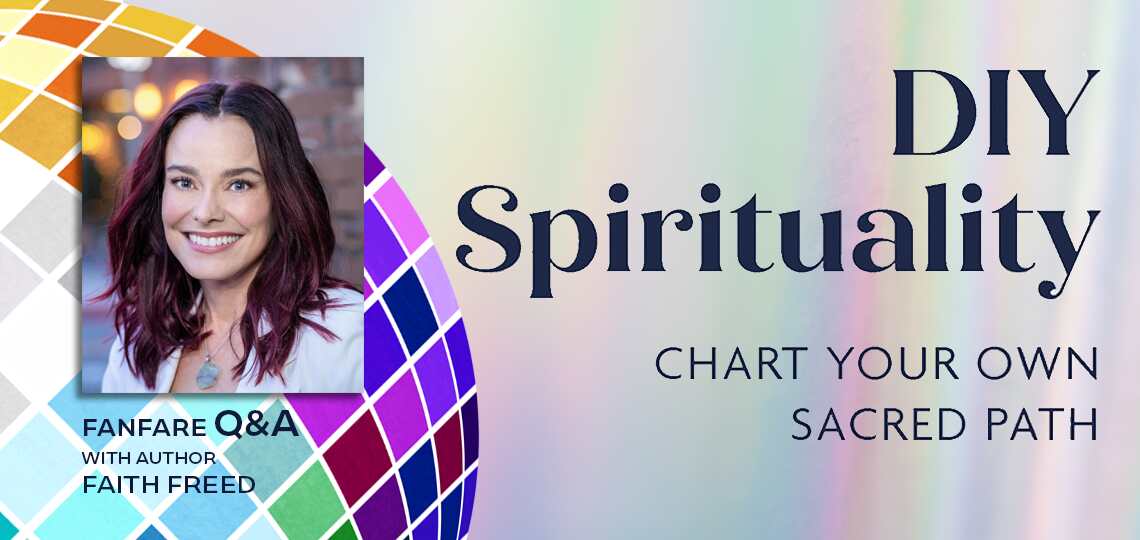
Reviewer Kristine Morris Interviews Faith Freed, Author of DIY Spirituality: Chart Your Own Sacred Path
For decades, Pew Research has documented a decline in the percentage of Americans who identify with organized religion. While it’s not clear how or why their beliefs have changed, belief in “something spiritual beyond the natural world” remains strong, with 80 percent of Americans expressing this view, according to Pew. Even so, it’s difficult to neatly separate and define concepts like religion or “spirituality,” but one thing is certain: many believers are embracing the freedom to ask newfound questions, whether they belong to a spiritual community or not.
Psychotherapist Faith Freed finds this everchanging search for meaning a positive indicator of the innate human need to maintain a connection between Self and an ineffable Source. Untold millions of us realize that spirituality “is an aspect of life that deserves attention,” she says, and how we go about attending to those beliefs isn’t as important as simply doing it.
Faith is the author of DIY Spirituality: Chart Your Own Sacred Path, a fantastic new self-help guidebook which earned a glowing review from Kristine Morris in Foreword‘s January/February 2026 issue. Hoping to learn more about the book and Faith’s ideas, we connected reviewer and author for an inspiring interview.
Your book, DIY Spirituality, brings the message that “it’s not the religion that matters, it’s the relationship,” and offers suggestions and guidance for crafting a rich, meaningful connection with the divine. Please share your background in psychotherapy and spiritual guidance, and what there is in your background, training, and experience that made you a good fit for the book’s topic.
At an early age, I began a casual exploration of different belief systems, given that I had a Christian mom, a scientifically minded dad, whose beliefs shifted, and friends who embraced different traditions. I opted to curate a personal spirituality based on what resonated, including meditation, yoga, choir, nature, etc. Later, I pursued my career as a psychotherapist, at the no longer Institute of Transpersonal Psychology. That’s where I realized I was a so-called spiritual eclectic. It felt good to have a label other than “spiritual-but-not-religious,” but I was struck by the feeling that the enormous group of people this term encompassed seemed largely overlooked.
As I pursued my second master’s degree I focused on the intriguing overlap between spirituality and psychology and got credentialed in both spiritual guidance and clinical psychology. I began practicing spiritual guidance, first, in San Francisco, and later became a licensed psychotherapist (LMFT) in California. As a natural born seeker and clinician as well, my personal and professional experience have informed this book. I dedicate it to young adults because I felt internally adrift during that launching phase and really could’ve used some reassuring inspiration, delivered with short-attention-span-friendly sparkle.
You take a lighthearted approach to spiritual exploration and crafting a unique, personal spiritual practice. How is this approach different from the way mainstream religious organizations handle the development of a relationship with the divine?
Whether your spirituality includes a religious organization or not, your connection with your Self and your Source is worth paying attention to. If you don’t find the right community or place of worship, a spiritual life is still worth pursuing. If you buy the premise that spirituality is an aspect of life that deserves attention, along with health and fitness, social life, work, etc., then the question isn’t so much how you attend to it, but whether you do. Here’s a simple analogy: In order to be healthy, strong and fit, some people hire a trainer, join a club, or attend exercise classes. Others like to run, hike, swim or do yoga solo. They all get fit, but how they do it differs according to their preferences and needs. Spirituality can be viewed similarly. Whether it’s in community, solo, or a combo, just do it.
Most of us, in one way or another, have been taught not to trust our feelings, but your book calls us to pay attention to them and the messages they bring. What brought you to the awareness that our feelings could be important indicators of who we are, apart from what others tell us we “should” be? How can we learn to go against the inner voices that tell us our feelings are not to be trusted?
Think of your feelings as messengers from your body intelligence. Your brain isn’t the only smart part. Your heart and gut are informants not to be ignored as well. There is a dance between logic and feelings. But what often gets missed is that feelings are just as true as facts in terms of your inner compass. However, just like thoughts, feelings can be helpful or not. When a feeling hits, it’s important to discern what the message is, and let the emotions move through you. Pay attention, learn what it’s there to show you, and then let the feelings pass naturally. It’s kind of like handling your automatic thoughts. Thinking is helpful but not overthinking, right? If you experience feelings that are overwhelming or you can’t discern whether to trust them, consider unpacking this with a trusted therapist. It’s OK to need help sometimes.
How do you suggest learning to distinguish which of our feelings may actually not be reliable indicators of who we are, who we are meant to be, and what our real values are, and which of them are authentic to us and may be protective of our unique values and beliefs?
When a feeling comes in, notice it before you build a story about it in your mind. Just take it at face value with a little space. For example, “I notice a feeling of impatience.” Then meet the feeling with compassion and understanding. “That makes sense because those people cut in front of me in the queue.” Then soothe yourself. That feeling has served it’s purpose and you can let go of it as soon as its willing to fade. The feeling was pure. What you do with it and whether you act on it is where your values and beliefs come in. These are thought forms. So if patience is a value, maybe you wait. If justice is a value, maybe you speak up for yourself or make sure no one else steps in front of you.
Feelings can be based on survival instinct, history, trauma, inner truth, or all of the above. It might be a good practice to notice the feeling as it arises, name it, and then quietly inquire what it is communicating to you. Then use your good judgment to act or not, according to your wise mind, beliefs, and values.
Your book makes spiritual discovery a holistic process linking body, mind, and spirit. In working with your clients, what do you find to be the greatest reason that a person may override messages from his or her own body, mind, and spirit that call attention to the fact that their religious practices may no longer be serving them?
Sometimes people can’t easily do what resonates because of societal, cultural, and familial traditions, expectations, or pressures. Often, the path of least resistance is to go along with the status quo. Everyone’s circumstances are unique. Ideally there is alignment between internal truth and external experience, but that is only possible when there is freedom and safety. Spiritual guidance can be a great resource when there is confusion or difficulty sorting this out. Even if you have obstacles to engaging fully with DIY Spirituality, you can have an intimate relationship with your Source that’s nobody else’s beeswax.
What are the main elements you’ve found to be essential to making a spiritual practice meaningful and sustainable long-term?
Once you’ve tried enough things to satisfy your curiosity, choose a few that work and work them. There are times when a practice is just a habit, and it may not feel especially magical or transformative. However, it’s important to keep it up, even in the mundane times. This is a foundation that will be there for you when you really need it, in good times and bad. It’s important to keep up your practices regularly, even when you don’t feel like it, to stay spiritually buoyant.
How do those seeking to create a unique and meaningful spiritual practice couple their need for freedom to question and explore with their need to belong to a spiritual community? Are the two drives necessarily contradictory?
The need for freedom and the need to belong are both real. When the two needs are met in the same place, you’ve got something. However, realistically, that might be a long shot. But if your ability to find community and belong still allows you the freedom to do your own exploration as well, that’s pretty cool. The spiritual community could be the broth that holds your soup du jour together. If belonging feels good and you are also free to question and explore as well, does that work for you?
If you are willing, please describe your own spiritual practice, and what the elements you’ve included mean to you.
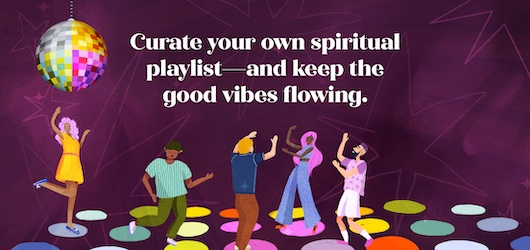
You’ll find me dancing under our divine disco ball of a moon with tears of wonder and gratitude.
Is your practice solitary, communal, or a little of each?
Mostly solitary. However, I occasionally practice a form of spirituality with others, which can be extremely soulful, joyful, and inspiring. A collective moment of silence, a song sung together in praise, carefree celebration with others, being in nature together, a yoga class, a family hike, or just a one hit wonder anywhere at all. Humanity is my spiritual community and solitude is my spiritual home base.
Your book is so full of joy—was the actual writing of it a joyful thing or a struggle?
It’s like childbirth—if you have any idea what that’s like.
What is the message you most hope readers will take away from your book?
IS-in-Charge.
What plans do you have for the future? Can we hope for another book, and if so, what is its topic?
Currently, I’m exploring ways for young adults and DIYers of all ages to signal their spirituality without definition or explanation. I look forward to the launch of this punchy gift book, spreading stardust, and whatever IS cooks up with me next.
DIY Spirituality
Chart Your Own Sacred Path
Faith Freed
The Collective Book Studio (Dec 9, 2025)
Psychotherapist and spiritual guide Faith Freed’s witty self-help guide is about creating a unique, eclectic, and satisfying spiritual practice.
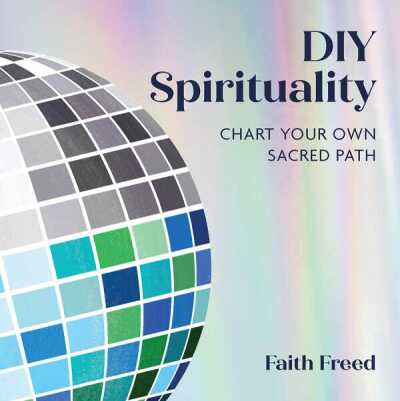
Declaring that “it’s not the religion that matters, it’s the relationship,” the book sets rules, regulations, hierarchies, and halos aside to extend a high-spirited invitation to a “divine party.” Its exuberant verbal and visual disco-era imagery evokes joy and freedom, feelings that also arise, the book suggests, when the authentic self is in communion with the divine.
The book’s suggestions for creating a sustainable and transformative personal spiritual practice are powerful. Designed to foster self-awareness and sensitivity to the presence of the source of all that is, its accessible exercises, like “marking miracles” and choosing a personal talisman, enhance awareness of the continual love and support of the divine. “What makes one person’s spirit soar is different from what lights up another’s,” it declares, encouraging seekers to explore diverse paths and select what resonates with their spirit and values.
A spiritual self-help guide that’s tuned in to joy, DIY Spirituality is for all who hunger for a personal relationship with the divine.
Reviewed by Kristine Morris
January / February 2026
Kristine Morris


