
Book of the Day Roundup: March 2-6, 2026
The Department of What It (Really) Means to Be Human
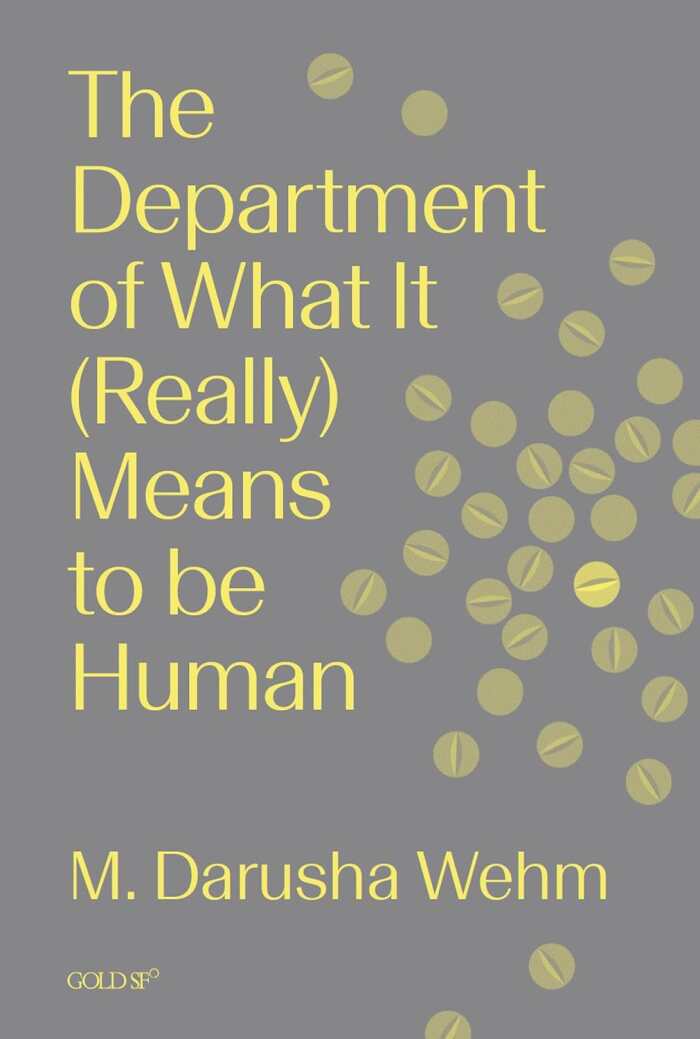
M. Darusha Wehm
Goldsmiths Press
Softcover $12.95 (224pp)
978-1-915983-46-6
Buy: Local Bookstore (Bookshop)
Suffused with supreme empathy, M. Darusha Wehm’s The Department of What It (Really) Means to Be Human is a probing speculative novel about the seductive landscapes of one’s memories.
In New Zealand in 2043, life is more equitable. A universal living wage has been established, eliminating the need for daily work. Neurodivergent Emerald is one of many people who works anyway. They are restless unless they have a task to focus on. A former police officer who has difficulty connecting to other people, but who is magnificent in the kitchen, they are now an investigator for the Grants and Stipends Office, tracking down wayward artists. Their latest subject is Gen Ecks, a famed installation and performance artist in her sixties, of whom Emerald’s justice-driven roommate, Anya, is a fan.
Emerald learns that Gen Ecks has been taking Moneta, a repurposed Alzheimer’s treatment drug whose effects are akin to “a kind of time travel.” Subject to unintended side effects, Gen Ecks is lost in her memories, experiencing them as if in real time. Though Emerald knows they should just report Gen Ecks to their office and move on, with Anya’s encouragement, they instead get involved—learning all that they can about the drug and what might be done to pull the artist back to the present. Complicating their pursuits is a person from their past who follows them, representing abandoned values and unanswered needs.
Even in this near future setting, which is marked by holographic experiences, neurological implants, and extended life expectancies, “progress doesn’t mean perfection.” The novel’s tension is wrapped up in understanding the melancholy that sets in when what’s new stops being novel and begins to feel normal. Emerald, who in their previous life was “careful to never actually care,” is an ideal guide through this somewhat surreal futurescape, learning as the audience does about the chasm between ideals and realities. The concern that they develop for Gen Ecks is heartening, and their increased comfort with taking righteous actions, coupled with their realization that they’ve formed a true partnership by accident, leads the novel to a satisfying close.
Set in a post-capitalist society wherein better does not yet mean great, and wherein some still wait to forgive and be forgiven, The Department of What It (Really) Means to Be Human is an enthralling speculative novel.
MICHELLE ANNE SCHINGLER (February 17, 2026)
Raised by Ferns
A Memoir

Maya Jewell Zeller
Porphyry Press
Softcover $23.95 (264pp)
978-1-73675-587-7
Buy: Local Bookstore (Bookshop)
Maya Jewell Zeller’s poetic memoir-in-essays addresses issues of privilege, poverty, immigration, cultural literacy, and the power of nature.
The book centers Zeller’s life in the Pacific Northwest. “The Privilege Button” compares the comfortable home that she and her husband owned near Spokane to the circumstances of her “itinerant” childhood, when her father struggled with his businesses and her family lived in tenuous places including a gas station, barn, and car. With dry wit, Zeller mocks her mispronunciation of items on a menu as one measure of her “low elite-culture literacy.” “Complete the Sentence” considers the cultural knowledge necessary to answer basic questions on a college entrance exam.
Earthy images of nature abound, as with passages about mossy, fern-covered hills that include depictions of the weeds and berries that Zeller’s family gathered from fields for dinner. An essay on Zeller’s crumbling marriage features musings on a river mysteriously filled with dead deer. The “dormant sticks” that blossom in spring are reminders that “you can hold the past inside yourself like a little doll.”
Thought-provoking observations about the process of crafting a memoir abound. The book is critical of “poverty porn”; memoirs like Hillbilly Elegy, it says, portray rural America as “piles of junked cars or the aftereffects of generations of societal neglect.” Zeller has no interest in positioning herself as a transcendent hero, as a “Kid from a House with No Plumbing [Who] Becomes Tenured Academic.” The book implies that there is danger and hurt in “anyone’s life”; Zeller’s writing students are encouraged to “mesh different things together,” to invent something “revelatory.”
Raised by Ferns is an ingenious memoir-in-essays that recalls a lifetime of determination.
KRISTEN RABE (February 25, 2026)
The Lost Robot

Joe Todd-Stanton
Flying Eye Books
Hardcover $17.99 (32pp)
978-1-83874-072-6
Buy: Local Bookstore (Bookshop)
A broken robot goes in search of its forgotten home in this thoughtful picture book about how nothing—and no one—is ever truly broken. In a futuristic world marred by the consequences of overconsumption, a decrepit robot wakes in a rubbish dump; it searches for the boy it was gifted to, only to find it has been replaced by a newer model. A mother and daughter rescue and repair the robot, giving it a true home—one where love endures.
DANIELLE BALLANTYNE (February 25, 2026)
Rigsby WI
Vol. 1: Foothold

S. E. Case
Iron Circus Comics
Softcover $15.00 (128pp)
978-1-63899-141-0
Buy: Local Bookstore (Bookshop)
A troubled but resilient teenager and her friends are profiled in the suburban coming-of-age graphic novel Rigsby WI.
Beth is somewhat new to Rigsby, Wisconsin, where she is homeschooled by her Aunt Alice to escape her mother’s domineering rule. One of her friends, Jeordie, is dating Jenna. Everyone else has to decide whether to go to the upcoming homecoming dance and who to ask.
The characters span the breadth of high school student existence; all are intriguing enough to merit ample attention. Their interweaving plotlines capture the complexity and drama of the teenage years from multiple perspectives. A swirl of school, family, medications, unrequited love, and petty theft, the story is at turns funny and touching.
Subtle differences in people’s speech, as with one person mentioning “Lyme disease” while another refers to it as “Lymes,” contribute to the book’s verisimilitude, as does the rich, detailed artwork. “What to wear to the dance?” is a big question for the teenagers, and the clothing worn in each panel reveals hidden aspects of who they are: Some don formal wear, others ratty T-shirts. In both language and appearance, Rigsby is an appealing world that begs to be revisited. While the dance is this volume’s grand conclusion, there are hints at interesting developments in the future.
Rigsby WI is an excellent graphic novel in which young people navigate the pleasures and perils of adolescence.
PETER DABBENE (February 17, 2025)
Wildly Different
How Five Women Reclaimed Nature in a Man’s World

Sarah Lonsdale
Manchester University Press
Hardcover $29.95 (296pp)
978-1-5261-6869-6
Buy: Local Bookstore (Bookshop)
An inspiring historical treatise, Sarah Lonsdale’s Wildly Different explores the unconventional lives of five women who defied limiting cultural norms to impact environmental causes.
Mina Hubbard went on expedition in northern Labrador, Canada, to map the region’s Naskaupi and George Rivers. Evelyn Cheesman conducted entomological research in the South Pacific Islands. Dorothy Pilley was a pioneer in global mountaineering. Ethel Haythornthwaite advocated for public outdoor spaces, helping establish England’s first park system. And Wangari Maathai, a Kenyan environmentalist, founded the Green Belt Movement to save her country’s forests.
The women’s personal journals, published works, and expansive research are referenced to extol their influence, as with Hubbard’s map denoting personalized locations, identification of new insect species bearing Cheesman’s name, and Pilley’s memoir, Climbing Days. Black-and-white photographs are included, depicting, for instance, bold Haythornthwaite speaking to encourage the Peak District’s safekeeping, and down-to-earth Wangari smiling into the camera.
The prose is rich and potent, helping to capture standout scenes, as of the terror of Pilley scaling a ridge on Dent Blanche in the Alps. And though the women lacked firsthand knowledge of each other, their connections herein are drawn via their shared values of courage, determination, and persistence to save local habitats. Further, the text unpacks how the outdoors remain a “contested space” for women in contemporary times and calls for a defense of natural spaces in the face of social and governmental restrictions. Optimism is also expressed for the possible rehabilitation of ecological landscapes.
Lauding five ecology-minded women leaders, the enlightening biographical compilation Wildly Different shows how its subjects turned their passion for the environment and science into grand legacies.
KATY KEFFER (February 25, 2026)
Kathy Young


