

A groundbreaking book by an Autistic and ADHD psychotherapist that doesn't speak about you, it speaks with you.
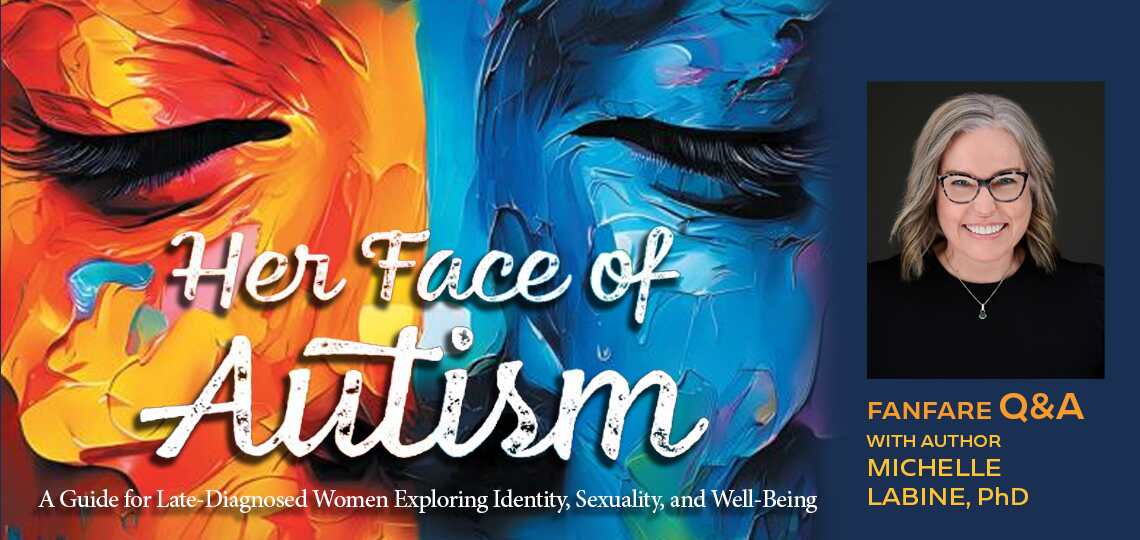
Reviewer Aimee Jodoin Interviews Michelle Labine, Author of Her Face of Autism: A Guide for Late-Diagnosed Women Exploring Identity, Sexuality, and Well-Being
The book industry introduces us to an endless number of interesting, talented authors but in the case of Michelle Labine, we couldn’t help but feel both awed and humbled when we learned she worked for decades as a psychotherapist before she realized she had autism and ADHD. For all those years, Michelle thought her exhaustion, relational confusion, and other struggles were personal weaknesses NOT something more serious. But only when she worked to help her son with his autism diagnosis did it occur to her that she may be neurodivergent as well. Strikingly, she is certain her autism and ADHD make her a better therapist because of her intuition and ability to recognize energy changes in her clients.
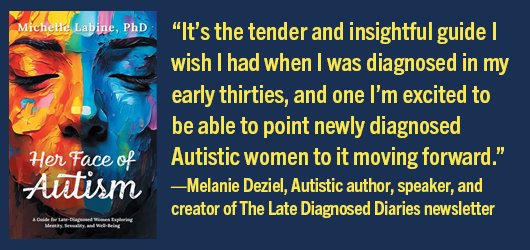
Michelle is with us today to talk about Her Face of Autism: A Guide for Late-Diagnosed Women Exploring Identity, Sexuality, and Well-Being, which recently earned a glowing Foreword Clarion review from Aimee Jodoin. In her review, Aimee calls the book a “humane and encouraging guide for autistic women who want to reframe their personal, social, and sexual identities after diagnosis to be more compassionate with themselves.
Enjoy the conversation.
You sought an autism diagnosis after your child was diagnosed as a teen and felt it was “clarifying and deeply unsettling all at once” because of your years of experience as a therapist. What sparked your desire to then write this book?
The desire to write this book grew organically out of everything happening at once. I was completing my PhD at the same time my son was diagnosed as a teenager, which led me to begin questioning my own neurology. Receiving my autism diagnosis was both clarifying and deeply unsettling especially as someone who had spent decades working with people in the field of social services and mental health within systems that had not named or recognized what I was now seeing so clearly.
As my doctoral studies unfolded alongside my own unmasking, it became impossible to separate the personal from the professional. I could see, with increasing clarity, how women, particularly late-diagnosed women, have been largely left out of the autism conversation. Our experiences are often misunderstood, minimized, or missed entirely. Writing this book became a way to speak into that absence and to put language to experiences that so many women carry alone.
This book is also deeply rooted in advocacy. While I wrote it for women who are still searching for understanding, I also wrote it for my own child. I wanted to contribute to a world where understanding comes earlier, where difference isn’t pathologized, and neurodivergent people are met with compassion rather than correction.
Through this book, I integrate lived experience, clinical insight, research, and story as interconnected forms of reflection, recognizing that it is through reflection that meaning, identity, and understanding emerge. Writing this book was an act of insistence: that our voices matter and always have.
In my research to understand myself and to write this book, I was mortified to learn how in early history autistic people and other neurodivergent individuals were positioned as problems to be managed rather than humans to be understood. Long before modern diagnostic labels existed, difference was feared, moralized, hidden, institutionalized, or erased. As medical and psychological frameworks emerged, many of these harms were simply renamed and recast as treatment, normalization, or care.
As I moved through this history, I kept picturing my own child. I imagined him moving through these earlier eras and I could not separate that from what I see and hear unfolding in the world today. The echoes are unmistakable. The resurgence of fear-based narratives, the push to “fix” difference, and the blaming of families, particularly mothers, are not relics of the past, they are reappearing in new forms.
That realization was frightening, and it removed any possibility of remaining silent. This book emerged as an act of resistance because telling the truth about history and asserting our humanity in the present is how we safeguard the future.
How did/does your autism influence your writing process? Did you feel a sense of catharsis or connection with the autism community while writing the book?
My autism and ADHD shape how I notice, organize, and make meaning of experience. I perceive the world in layers sensory, emotional, relational, and conceptual often all at once. Writing became the place where those layers could slow down, be sorted, and find language.
My autistic need for precision meant I wrote carefully and intentionally. If a sentence felt even slightly misaligned emotionally, ethically, or relationally I couldn’t move past it. I returned to it repeatedly until the language felt accurate and honest. This made the process slower than I wanted, but it also made it truer. Over time, I learned to trust that pace.
My ADHD contributed differently. It shaped the bursts of intensity, the periods of deep immersion, and the nonlinear way ideas arrived. I often wrote in concentrated waves, following connections quickly and intuitively, then later returning to structure, refine, and integrate. Learning to work with that rhythm rather than against it was essential to completing this book.
For many years, I believed the exhaustion, relational confusion, and complexity of my body, brain, and nervous system reflected personal shortcomings rather than neurodivergent difference. Writing this book allowed me to name those experiences as Autistic and ADHD-related and to situate them within a broader cultural and relational context. That re-framing was deeply healing.
There was a sense of release in writing like exhaling after holding my breath for a long time. I found myself saying things I had never articulated before, even privately. At some point, I realized I was no longer writing to explain or justify my experience, but from a place of clarity and self-trust.
Although much of my writing was done alone, I did not feel isolated. I felt accompanied by late-diagnosed Autistic women, by clients, and by voices I’ve encountered in community, along with those I haven’t met yet but know will recognize themselves in these pages. I offer this book as a companion and an invitation to read slowly, notice what resonates, and trust moments of recognition as they arise.
How does your autism influence your work as a therapist? For instance, are you able to detect behavioral patterns your patients may not? Also, did you notice a difference in your approach to therapy before and after your diagnosis?
My autism shapes how I listen, what I notice, and how I understand patterns over time. I tend to pick up on subtle inconsistencies between what a client says and what their body, affect, or relational patterns are communicating. Often, I’m tracking themes across sessions, repeated dynamics, shifts in language, changes in energy long before my client is consciously aware of them. I used to call this intuition, and maybe a part of it is that, but I now also see it as my autistic ability of pattern recognition combined with sustained attention.
I also tend to work at a depth that privileges accuracy over speed. If something doesn’t quite fit emotionally, relationally, or developmentally, I’m unlikely to move past it. I stay with it, name it carefully, and invite curiosity rather than interpretation. Many clients, particularly those who are neurodivergent or trauma-exposed, experience this as containing rather than intrusive.
Before my autism diagnosis, I was already an effective therapist, but I was doing so at a significant personal cost. I over-relied on masking, high empathy, and over-responsibility for the therapeutic process. I often assumed that if something wasn’t working, I needed to try harder, attune more, or explain better.
After diagnosis, my approach became more spacious and more precise. I stopped trying to translate myself into a version of therapy that wasn’t sustainable for me. I became more transparent about process, more explicit in naming patterns, and more respectful of nervous system limits, both my clients’ and my own. This has led to cleaner boundaries, clearer interventions, and a greater emphasis on collaboration rather than performance.
Perhaps most importantly, my diagnosis shifted how I locate difficulty. I am less likely to pathologize (or rely on diagnosis my clients present with) and more likely to contextualize distress within neurobiology, trauma history, relational environments, and social expectations. That shift has deepened my work, particularly with late-diagnosed Autistic adults, women, and individuals whose struggles have long been misunderstood or minimized.
My autism is integral to how I practice with clarity, depth, and a strong commitment to seeing what is actually there.
How did you find a balance between sharing research/academic material and incorporating the lived experience of women with autism in the book?
For me, my research in seeing the history of autism was de-pathologizing and healing in itself. My hope is that other women will have this experience as well—when they understand how autism was defined, who was studied, and whose observations were taken seriously, their experiences stop looking like personal failure and start making sense within a larger social and political context. My hope is that they will see the truth in the matter: that autism was shaped by gender norms, power, and whose knowledge was valued.
A striking example is Grunya Sukhareva, a Russian child psychiatrist who, in the 1920s, published detailed and nuanced clinical descriptions of Autistic children, including girls. Her work emphasized internal experience, sensory sensitivity, and individuality features that would later be sidelined. Because she was a woman, publishing in German and Russian, and working outside dominant Western academic centers, her contributions were largely ignored, while later male researchers were credited with “discovering” autism decades afterward.
Understanding this history matters. It shows that women were not missing from autism; they were rendered invisible by the research lens itself. Placing autism within the context of feminist scholarship, disability rights, and the neurodiversity movement reframes it from a disorder of deficit to a form of difference shaped by social forces. For many women, that reframing is profoundly healing. It replaces shame with context, and self-blame with understanding.
That is why this book moves between research and lived experience. The research provides history and structure; lived experience reveals the cost of that history. Together, they offer a fuller, more humane way of understanding autism.
Your book starts a conversation about autistic women and sexuality—namely how autism can interfere with communication and the sensory overwhelm involved in intimacy—and what accommodations autistic women can advocate for to cultivate a satisfying sex life. What do you hope will be the greatest takeaway from this section of your book for autistic women seeking more fulfilling intimacy?
What I hope Autistic women take away from this section is that there is nothing inherently wrong with how they experience desire, intimacy, or connection. Many of the difficulties we encounter in sexual relationships come from mismatches between nervous systems, communication styles, sensory thresholds, and cultural expectations.
I want women to understand that sensory overwhelm, delayed processing, difficulty reading implicit cues, or needing more explicit communication are not barriers to intimacy, they are information. When those experiences are named and respected, intimacy often becomes more possible, not less. The goal is not to “push through” discomfort in order to appear normal but to build sexual relationships that are responsive to how one’s body and nervous system actually work.
Another key takeaway is that accommodations in intimacy are not excessive or selfish. Asking for clear communication, pacing, predictability, aftercare, and sensory modifications is an act of self-knowledge. For many Autistic women, simply realizing that they are allowed to advocate for their needs without apologizing or overexplaining is deeply liberating.
Finally, I hope this section helps women separate sexuality from performance. A fulfilling sex life does not require meeting someone else’s script of spontaneity, frequency, or intensity. It requires consent, safety, and mutual curiosity. When Autistic women are supported in naming their needs and limits, intimacy can become something we participate in with presence rather than endurance.
If this section leaves readers with one lasting understanding, I hope it is this: satisfying intimacy begins with listening to your body, trusting your perceptions, and allowing relationships to adapt accordingly.
You touch on the topic of trauma and the sexual self-concept with deep empathy and the acknowledgement that “therapy must include an understanding of how autistic traits intersect with trauma and how many of our coping mechanisms, often mistaken for personality traits, developed as shields in a world that was not built to include us”—it’s a subject that could be expanded into a whole book on its own. In what ways do you believe therapy should navigate the overlap between neurodivergence, sexual trauma, and LGBTQ+ identities?
Autistic individuals are at significantly higher risk of boundary violations, relational harm, sexual violence, and trauma. This vulnerability is not inherent to autism itself but to the social environments Autistic people often grow up in, environments that prioritize compliance, punish difference, and frequently fail to recognize or respect autistic communication and sensory needs. Over time, many Autistic people learn that safety depends on accommodating others rather than trusting their own limits.
A significant part of this vulnerability lies in how often autistic people are not believed. Autistic communication is frequently misread: flat affect interpreted as indifference, delayed processing mistaken for avoidance or evasion, shutdown misread as consent, and sensory distress dismissed as overreaction. When Autistic people express confusion, discomfort, or harm, their experiences are often minimized, questioned, or reframed as misunderstanding or poor judgment. Repeated exposure to this kind of invalidation erodes trust in one’s own perceptions and makes it harder to name harm or assert boundaries when it matters most.
Because of this context, therapy must approach trauma with an understanding that many coping strategies developed early and were adaptive at the time. People-pleasing, dissociation, shutdown, sexual compliance, difficulty identifying desire, or confusion around boundaries are often survival responses shaped by repeated relational harm not fixed traits or character flaws. Without that lens, therapy risks reinforcing shame or encouraging further self-betrayal.
When sexual trauma is part of the picture, therapy must be especially careful not to replicate dynamics of override or coercion in the name of healing. Many Autistic clients have learned to disconnect from bodily signals, to endure discomfort, or to prioritize others’ needs as a way of staying safe. A trauma-informed, neuro-affirming approach must therefore foreground bodily autonomy, explicit consent, pacing, and choice often long before sexual material is addressed directly.
Not all Autistic people are LGBTQ+, but for those who are, these identities intersect in ways that further increase vulnerability. LGBTQ+ people already face higher rates of stigma, boundary violations, and sexual harm within our culture; when combined with autism, particularly with masking, sensory differences, and difficulty being believed, those risks are often compounded. For some of us, recognizing our sexual orientation or gender identity occurs alongside unmasking, not because identity is caused by autism or trauma, but because greater safety and self-honesty make it possible to see what was previously obscured.
At its best, therapy holds all of this together. It resists rigid frameworks, prioritizes collaboration and transparency, and remains attentive to nervous system needs. It validates difference while remaining curious about pain. And it recognizes that healing for Autistic, trauma-exposed individuals often looks more like unlearning compliance, shame, and the belief that intimacy requires endurance. The goal is to support the development of a sexual self-concept rooted in safety, agency, and authenticity.
And yes, this is a subject that could—and should—be the focus of an entire book. What I offer here is an opening: a way of naming patterns that have too often been misunderstood or ignored, and of making room for deeper, more nuanced conversations to follow.
You live in Canada; the current political environment of the US next door seems to be exacerbating the stigma against autism (anti-vaccine rhetoric, Tylenol misinformation, etc.). What do you think our political situation means for autistic adult women in particular?
While much of this rhetoric is currently more visible in the United States, it would be inaccurate to treat it as contained there. We are seeing related dynamics emerge in parts of Canada as well, particularly in regions where right-aligned political movements are influencing public discourse around health, science, and individual responsibility. The degree may differ but the underlying logic is familiar.
What’s most concerning is how quickly these narratives return to blaming women. Claims about vaccines, medications, pregnancy, or parenting practices echo older, discredited frameworks, most notably the idea of the “refrigerator mother,” where women were held responsible for their children’s autism through supposed emotional coldness or failure. Today’s version is framed through misinformation and moral panic but the outcome is the same: women’s bodies, choices, and behaviors are positioned as the cause of autism.
There is also a troubling proximity to eugenic thinking. When autism is framed as something that should have been prevented through better choices, better screening, or better control it suggests that Autistic lives are less desirable. That message may not always be stated outright, but autistic people, especially those coming to diagnosis in adulthood, feel its weight. It reinforces shame and undermines the legitimacy of autistic identity.
These narratives also have material consequences. When autism becomes politicized rather than understood through evidence and lived experience, funding priorities shift, adult services remain underdeveloped, and supports for Autistic women are deprioritized. The very people most affected by these policies are often the least represented in the conversations shaping them.
At the same time, there is resistance. Autistic adults, particularly women, are increasingly visible, informed, and vocal. We are challenging these narratives, naming our historical roots, and refusing to accept blame for neurologies that have always existed. Our collective voice matters because stigma thrives when history is forgotten.
Understanding the political and historical context is protective. It helps Autistic women recognize that what we are pushing against is not personal failure but a recurring cultural pattern and one that can be named, challenged, and changed.
What do you see as the future for autistic diagnosis and support, both in the near future and in the long-term?
My hope is that autism diagnosis and support continue to move toward a more humane, lifespan-oriented model, one that recognizes neurodivergent experience early, particularly for women and gender-diverse adults, and offers clarity rather than stigma. Ideally, diagnosis would become more contextual and collaborative, and support would focus on needs, nervous system care, relational safety, and identity integration rather than normalization.
What feels less realistic in the near term is a fully accessible or cohesive system. Diagnostic pathways remain uneven and costly, many clinicians are still trained using outdated, male-centered models, and adult supports continue to be fragmented or crisis-driven. While awareness and self-advocacy are growing, meaningful structural change tends to move slowly. For now, progress is more likely to be incremental, driven by lived experience, peer-led resources, and a gradual shift in how autism is understood rather than the result of sweeping systemic reform.
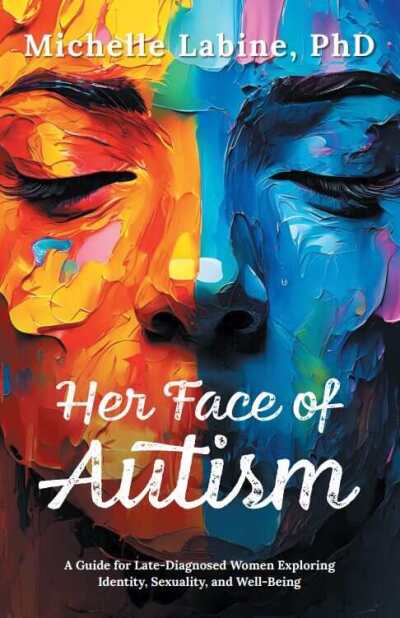
Her Face of Autism
Clarion Rating: 4 out of 5
Acknowledging the diverse and personal nature of autism, Her Face of Autism is a compassionate guide.
Psychotherapist and sex therapist Michelle Labine’s compassionate guide Her Face of Autism is about late autism diagnoses in women.
The autism diagnosis of Labine’s child made her reflect on her own experiences with social anxiety, routine rigidity, and sensory issues. She was herself diagnosed with autism in middle age. She draws upon that personal knowledge in this guide for women who were also diagnosed late in life or who suspect they are autistic. The text defines autism and its varied symptoms in the context of adult women’s lives, noting that women are taught how to hide social issues, sensory sensitivities, and sexual difficulties, making the detection of autism harder and leading to delayed acceptance of external support.
The book’s in-depth definition of autism spans two full chapters, delving into myriad signs and symptoms, including executive dysfunction, heightened sensitivity to sound and light, and manual rather than intuitive processing of social cues. This expansive definition acknowledges the diverse and personal nature of autism and recognizes that broad generalizations of autism contribute to delayed diagnoses and feelings of alienation. The assertion that “you do not need an official diagnosis” to “advocate for what you need to be successful in life” widens the scope of the book to incorporate empathy for those without the resources to attain a diagnosis; still, the analyses and advice remain targeted.
Navigating the stigmatized sexual well-being of autistic women takes center stage in the book’s latter half, which shares the stories of autistic women who faced the struggles outlined in its chapters, showing masking and sensory issues in action. But some generalizations are made, and there is some vagueness in the language of the text. Its discussions of sensory sensitivities and struggles with picking up on social cues come without sufficient specifics. For instance, a woman’s partner is reported to have “misinterpreted her direct communication style and her need for solitude as coldness or emotional distance. He dismissed her sensory sensitivities, labeling them as overreactions or dramatics,” but the subsequent list of such struggles and their consequences is too academic.
In general, though, this is an empathetic text. It employs “we/our” throughout to convey Labine’s personal familiarity with the subject, and it takes pains to show respect for autistic women’s intellect and desire for self-awareness and self-actualization. The reflection questions at the end of each chapter, though, are too amorphous and repetitive, asking “What influence does autism have on you?” and “What influence does autism have on your relationships, communication, and sexual identity?” More varied and specific are the book’s suggestions for adapting, including ways to support sensory needs during intimacy.
Her Face of Autism is a humane and encouraging guide for autistic women who want to reframe their personal, social, and sexual identities after diagnosis to be more compassionate with themselves.
Reviewed by Aimee Jodoin
November 13, 2025
Aimee Jodoin


