
"A beautifully written kaleidoscopic novel"
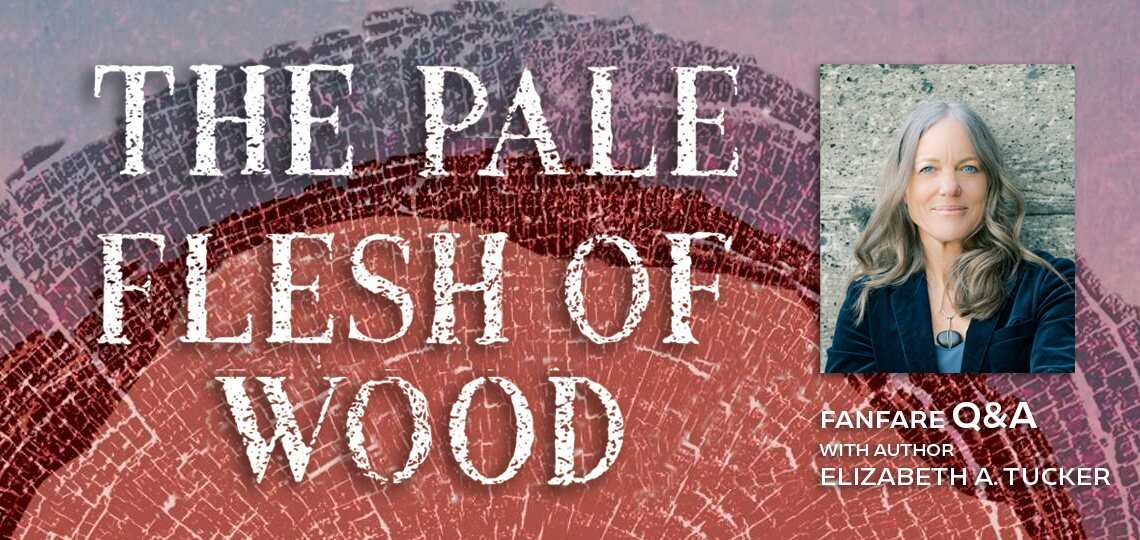
Reviewer Mari Carlson Interviews Elizabeth Tucker, Author of The Pale Flesh of Wood
The tongue-in-cheek quip about what it takes to be a good writer, you simply sit down at the typewriter, open your veins, and bleed, is of uncertain origin, but most anyone who has stared anxiously at a blank page—or screen—knows the feeling. Good writing must come from somewhere deep, and for some professional writers—like today’s guest, Liz Tucker—it requires sitting down at the keyboard and opening your heart.
As Liz says in the interview with reviewer Mari Carlson below, “there is a certain vulnerability in dedicating ourselves to the quiet, private study, practice, and execution of the [writing] art itself and then the bold act of putting it out there for the world to see? It’s a little akin to taking off your bathrobe and inviting the wider public (strangers, friends, and loved ones alike) to examine and comment on your naked, exposed body—beauty, muscles, love handles, skin tags, and all. It’s both thrilling and terrifying.”
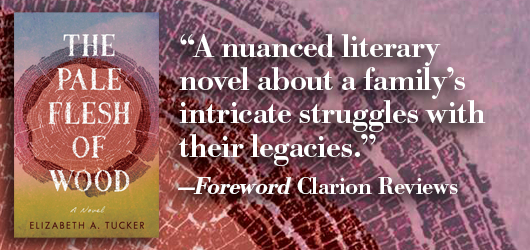
In her glowing Foreword Clarion review of Liz’s novel The Pale Flesh of Wood, Mari describes the book as a “nuanced literary novel about a family’s intricate struggles with their legacies.” She says the family relationships are explored via “coy, vicious, and humorous exchanges with one another,” and that their “feelings are entangled and intense.”
With her own six-generation legacy in the Golden State of California, Liz obviously has the chops to write compellingly about family dynamics through good times and bad. We were thrilled when she agreed to connect with Mari for a conversation.
The title, The Pale Flesh of Wood, suggests an environmental embodiment of memories and emotions, a close connection between place and persons. How did the location(s) in which you wrote the book influence and inform the narrative? Are they the same settings as the book’s?
Such a great question and interpretation of not only the title but also one of the book’s central characters—the magnificent California Oak rooted at the epicenter of the book and has witnessed centuries of change. As for the locational influence, I wrote the story in the Sierra Nevada mountains where I live. That said, I am a proud six-generation Californian who has lived up and down this great state and have found examining its fault-prone environments as a way to influence my art has become my jam.
I do have a long family history in the area where the story takes place, and I lived in San Francisco for about twenty-years, so the general “place” is quite familiar to me and was not hard to reimagine in fictional form. California’s landscapes—especially those that have a habit of shifting beneath our feet or prone to landslides, wildfires, epic snowstorms, waves, and floods—are particularly intriguing as they have a way of informing how we as humans metabolize life, change, and the inevitable curveballs thrown our way. How do we prepare and brace for disaster? How do we react/respond to such seismic changes in our lives? And why do we often choose to stay in (or in Lyla’s case return to) areas that are prone to such relentless natural disasters? This is highly fascinating to me as a writer. Stability in fiction is meh. Stability is boring. But instability?— especially when it comes to unpredictability and vulnerability in landscapes and those places we call home, now we are talking! That is juicy, and terribly exciting to explore on a metaphorical level, and I can’t imagine such natural precariousness of the earth being absent in my future longer works.
Lyla’s dad dares her to do dangerous stunts and take risks, and is not always there to catch her when things go wrong. He hurts her, and yet, she admires his spirit and learns from him. What risks did you take writing this book? What supports made taking them possible?
First off, there is always a risk in creating art. The risk of: can we as artists pull off the act of not only writing a book, but a body of work we are proud of. Listen, there will always be critics out there; those ready to tear art (and artists) apart or those ready to applaud it. But there is a certain vulnerability in dedicating ourselves to the quiet, private study, practice, and execution of the art itself and then the bold act of putting it out there for the world to see? It’s a little akin to taking off your bathrobe and inviting the wider public (strangers, friends, and loved ones alike) to examine and comment on your naked, exposed body—beauty, muscles, love handles, skin tags, and all. It’s both thrilling and terrifying.
Ultimately, however, I believe that while I am the author of a story—the one who creates the narrative arc, its characters, its place, its imagery, its attention to language, its sound, its flow, etc.—I believe after publication the work belongs to the reader. They own their personal engagement with the story; they are entitled to their responses, their reactions whether they are good, bad, or meh. I do love hearing how people interpret the work and how it resonates with them, but you do just have to be a bit thick-skinned for the ways your work might have failed in certain reader’s eyes. But hopefully every artist finds the investment in and bold act of creating art, and taking the risks, are ultimately worth it.
That said, the biggest personal risk I took in writing this book did not become evident until well after it was published and I was at the end of the book tour—namely a person who has been very dear to me for nearly forty years was terribly triggered by the book on many levels and it may have cost our relationship. Needless to say, it has been a terribly shocking experience to receive his upset and anger at what I created and my audacity at writing literary fiction. I had always assumed this is what memoirists grapple with when publishing their art and the choices they have to make in the editorial process. But whole-cloth fiction? I had never in my wildest imagination thought publishing this book would have resulted in such a dramatic reaction from somebody I adore. I suppose it is a case of life imitating art, and the rippling effects of his childhood traumas resurfacing in terribly unexpected ways. Had I known this was a risk, would I have written this story? Published it? Gosh, without a crystal ball to see how this all played/plays out, that is hard to say. I am very very proud of the work and nearly every single word and sentence that makes up The Pale Flesh of Wood, the various awards it has received, but its publication has cost us something very dear.
As for what supports made writing this book possible? That’s easy—my husband, Matt. He is the most fantastic partner in the whole world and I am extremely lucky to have him by my side. He has always been a huge supporter of my going back to school to study the craft of writing, to take workshops, to engage in the long and expensive process of working with developmental editors, to navigating the ups and downs of publication; he has listened to and metabolized the long trail of woes of the process and has also been generous in his readings of my work, providing valuable feedback, and has been exceedingly generous in all the ways my art may have interrupted our other adventures together that take place off the page. And to my mom who has always been one of my biggest cheerleaders and always led me to believe that if I reach for the stars I might just touch one. As I said in my dedication, my mom not only gave me life, but taught me how to live. I am so grateful to them both for their unconditional love and support.
Lyla’s dad is a geologist. The book alludes to the make-up of the earth where the book mostly takes place, in California. Did you know about geology before you wrote the book? What kind of research went into writing it?
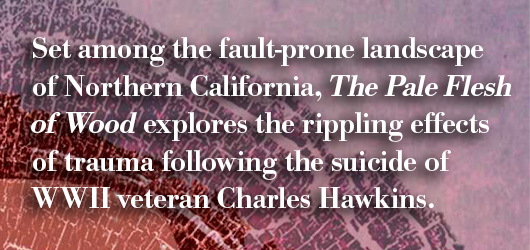
I am not a geologist, far from it. My husband, however, has always had a great deal of interest in the subject, as does my son who is a freshman at University of Oregon studying earth sciences. So, yes, I have gleaned a bit over the years: on our road trips, during dinner table discussions, and the like. Interestingly enough, the original title of the book was “Fault Lines” as I was metaphorically exploring the seismic fissures and the magnitude of instability within the Hawkins’ family relationships pre-dating Charles’s suicide and the long tail of aftershocks that continue to vibrate long after the event. Geology and seismology seemed like the perfect metaphor to explore and bake into the book’s DNA. Each chapter originally had a seismological definition—a geological marker, if you will—at the opening as a way for the reader to engage with the specific chapter.
So yes, I did a bit of research to make sure the chapters resonated accurately with the study of the earth’s instability. But during the cover design process, the publisher pushed for a title change—for the title to be more tree centric given the oak tree that stands at the epicenter of the novel. As such, I had to do a last minute stripping of some seismologic/geologic references and let the dendrology imagery carry the more obvious thematic weight. I absolutely love the title, The Pale Flesh of Wood, and all the way it better serves the book, how it also works in partnership with the earth sciences component. I hope those who give the book multiple reads will enjoy making those connections that reside underneath the story-line.
Though their relationship is fraught, Lyla is closer to her dad than her mom and her grandma. She pushes their boundaries and expectations. Talk about how the book tests femininity and traditional roles for women.
I do think Lyla intentionally and even unintentionally bucks the expected ideas of the female role of that time period. Lyla is definitely not of her mother’s generation, nor her grandmother’s. And she is no Gen Z’er. That is a fact! Some of that is just who Lyla is at her core and some of that might be a result of what was embedded in her at a young age—a time when her father and grandfather were her primary idols, how they saw and treated her, and what they expected of her. They saw (or perhaps wanted to see) Lyla in a different light, “the first female to pitch in the majors,” says Pops, or be the son that Charles had so desperately wanted. I think Louise and Caroline were simply more comfortable in their assumed role of femininity, and Lyla could just never square herself with those expectations and their own histories.
Moreover, Charles and Pops had shortened lives, and so they became almost mythical figures to Lyla and she probably felt very seen by them at a time that is so emotionally influential to young children. She revered the two of them and I have to wonder: had Charles lived longer would Lyla have always felt more emotionally closer to her father? I’m not so sure. I have to guess their relationship would have changed had Charles not taken his life and they all just plodded along as families do. I’m not convinced he would have remained so legendary to her. Is it possible she and Louise would have grown far closer in the later years had Charles not made his decision? I have no way of knowing, of course, but I think people whose lives are shortened can often become statically heroic.
Lyla is described as a survivor. Like the tree in her home-of-origin’s yard, the book’s central metaphor, she witnesses atrocities and abuses. Both she and the tree take beatings and make comebacks. How would you describe the relationship between Lyla and the tree and the message conveyed by their affinity?
Another great question, thank you! In writing this story, I started to become familiar with the term “witness trees,” which mostly refers to trees still standing today that have borne witness to significant historical events. But somewhere along the way I also came to believe that beyond those few famous trees still standing, we each have our own personal witness trees out there in the world and it is up to us to identify them and their significance. This majestic California Oak is Lyla’s witness tree. And it was likely Charles’ and Caroline’s tree as well. That oak had witnessed generations of the Hawkins’ family tragedies and turmoil (not to mention three hundred years of California’s histories) and its roots grew ever stronger and deeper. Like the tree, Lyla’s trunk, her heartwood, her sapwood, her cambium and pith, her canopy and roots, grew far stronger and richer too because of all that she has witnessed, navigated, and endured and the personal decisions she made in order to forgive and carry-on.
Spanning generations, Lyla’s coming to terms with her past and forging new relationships concludes not only positively for her, but for her wider world. How do you think the book speaks to this political and cultural moment?
Funny enough, while writing this book, I had questioned whether the story-line would have relevance; would it meet the moment. Given the trajectory of the mental health crisis in America, I decided it would have relevance but I’d never entertained the thought on how this book would speak to the current political and cultural discourse. The conversations today are so vastly different from the time the book was conceived. Many folks are in deep, pain, deep anger, deep fear—whether that is felt economically, emotionally, socially/culturally—and being inflamed politically.
I’m not suggesting these pains are new, but the fissures and rifts in our humanity seem to be widening and deepening. Communication is fairly horrible and destructive and creates tribalism. I do think if people could practice the radical act of sitting down with one another, eyeball to eyeball, take a deep breath, practice active listening, and practice respective sharing with calm respect and kindness, we could probably gain a better perspective of where each is coming from. We might be able to embolden our collective empathy, and act with more civility with those we don’t agree with. We all have different lived experiences that form our perspectives; that won’t change. But when we isolate ourselves from other people—whether that is emotionally or physically—the divide worsens.
Turning on each other does not seem to be a recipe towards healing. Similiar to Lyla and her trajectory, I think we could all be better off accepting we inhabit this big, beautiful world together and our differences will never go away, nor should they. But is there a way we can learn to listen? Be kind? Show up willing to gain new perspective? Flex our empathy muscle? Work through the scar tissue in order to forge bonds that allows differences to be accepted while finding commonality in a brighter future? I hope so.
Is there a character you identify with most in the novel? Did your mind change as they developed?
Writing a book of fiction is a wild, strange, and beautiful thing. While I’ve shared earlier that this story is not part of my family history or told from personal experience, I tried to rely on the emotional truth of how I would believe a person might act and react to the traumas the Hawkins’ family experienced. As such, I think I identify with each of the characters in one way or another, some characters more than others. I guess I see a little of myself in certain aspects of how each engage with themselves, with each other, and with the wider world. Funny enough though, I wrote this book when my kids were very little, so writing from Louise’s perspective about parenting the teen years felt very foreign and distant. Louise had always felt like a shadow character, someone I didn’t totally grasp or really even like all that much. But now having gone through the thrilling, joyous, and at times, hairball teenage rollercoaster years, I sort of have to laugh at and alongside Louise; I can better see why she acts in ways that are so unexpected and at times repelling.
I often say to people, Louise did not have a playbook on how to raise Lyla after the suicide, and simultaneously, attend to her own grief. She floundered. And I think that may be true for many parents: there is no singular playbook on how to raise your own kiddos; they come with their own set of gifts and challenges and you ride the ride, your unique ride. So I think I have gained a little more empathy for Louise than I had when I originally conceptualized her as a character and tried writing from her perspective.
All that said, If I really was to call out a specific character I most closely identify with, it would be the oak tree. As I mentioned earlier, I have a long lineage in California, my roots in this beautiful state run deep. It is where I have grown up from seedling, to sapling, to middle-age maturity: where I shed my bark and grew thicker skin, dropped my leaves and acorns to build a healthy canopy, where I expanded my root system, let my kids climb high upon my shoulders, let them swing from my branches, and tried to provide them and those I love with shelter and shade from the elements. Like the tree, I witnessed a lot in this amazing state over the past five-plus decades, not to mention all that I have absorbed and metabolized from the preceding generations that make up my epigenetic coding. And as in the Antoine de Saint-Exupéry quote I mentioned in the book’s dedication: The tree is more than first a seed, then a stem, then a living trunk, and then dead timber. The tree is a slow, enduring force straining to win the sky. Yeah, that seems pretty spot on, at least for me.
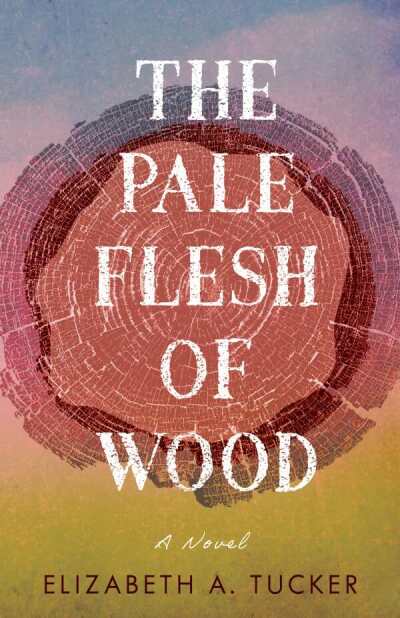
The Pale Flesh of Wood
Elizabeth A. Tucker
She Writes Press (Feb 11, 2025)
Clarion Rating: 4 out of 5
Family stories and regrets drive a woman away from home and pull her back again in the affecting literary novel The Pale Flesh of Wood.
In Elizabeth A. Tucker’s moving novel The Pale Flesh of Wood, a woman grapples with her family’s troubled history.
The ancient oak that lords over Lyla’s family’s property is the site of mixed memories. It ties Lyla to her grandmother, who owns the land; her father, who died there; and her punishing mother. In time, it drives her away from home; later, it compels her to return.
Split into three parts, the book tracks the reasons for Lyla’s departure, her time in Wyoming, and her return to California. The chapters focus on incidents that define Lyla’s family’s relationships: Lyla and her father hang a tire swing in the tree, and she attempts to prove herself by agreeing to the dangerous feats he directs; later, she steals her grandmother’s cherished porcelain doll and expresses resentment over her grandmother’s rules. A fight between Lyla and her mother when Lyla is a teenager precipitates her departure. When she returns in physical form to the place she could never truly leave, she feels a sense of grace and reassurance, recognizing her experiences of growth, death, and rebirth in keen terms.
The family’s relationships are explored in the course of its members’ coy, vicious, and humorous exchanges with one another, as well as through their internal thoughts. Their feelings are entangled and intense, and they are a codependent if multifaceted bunch. Lyla is curious about the world, loyal to her family members, and angry at her mother; her grandmother’s stern facade belies her feelings of guilt. Lyla’s mother, whom others dismiss as weak, has inner strength that flashes forward when she shows old family videos to Lyla, and Lyla’s father is a captivating, heartbreaking figure. The book’s secondary characterizations somewhat pale in comparison to the family’s, including when it comes to the pair of siblings Lyla stays with in Wyoming; they are cast as mere foils to her family members.
The book’s political and geographical landscapes are well attended to—thanks, in part, to the influence of Lyla’s father, an amateur geologist who’s interested not only in rocks and fossils but in “an investigation of how they change over time.” He teaches her about the stars, too, resulting in constancy when Orion is in view:
Unknown constellations filled the near-dawn sky—black holes, burned-out stars, and probably faraway myths that her father had never spoken of, never had the time to teach her about before he left.
World War II, the postwar period and its destruction of rural areas, and the Cold War all influence the book’s progression. It moves toward a satisfying ending that’s all about forgiveness and compassion, grounded in recognition of the overwhelming forces that threaten to break people.
The Pale Flesh of Wood is a nuanced literary novel about a family’s intricate struggles with their legacies.
Reviewed by Mari Carlson
October 15, 2024
Mari Carlson


